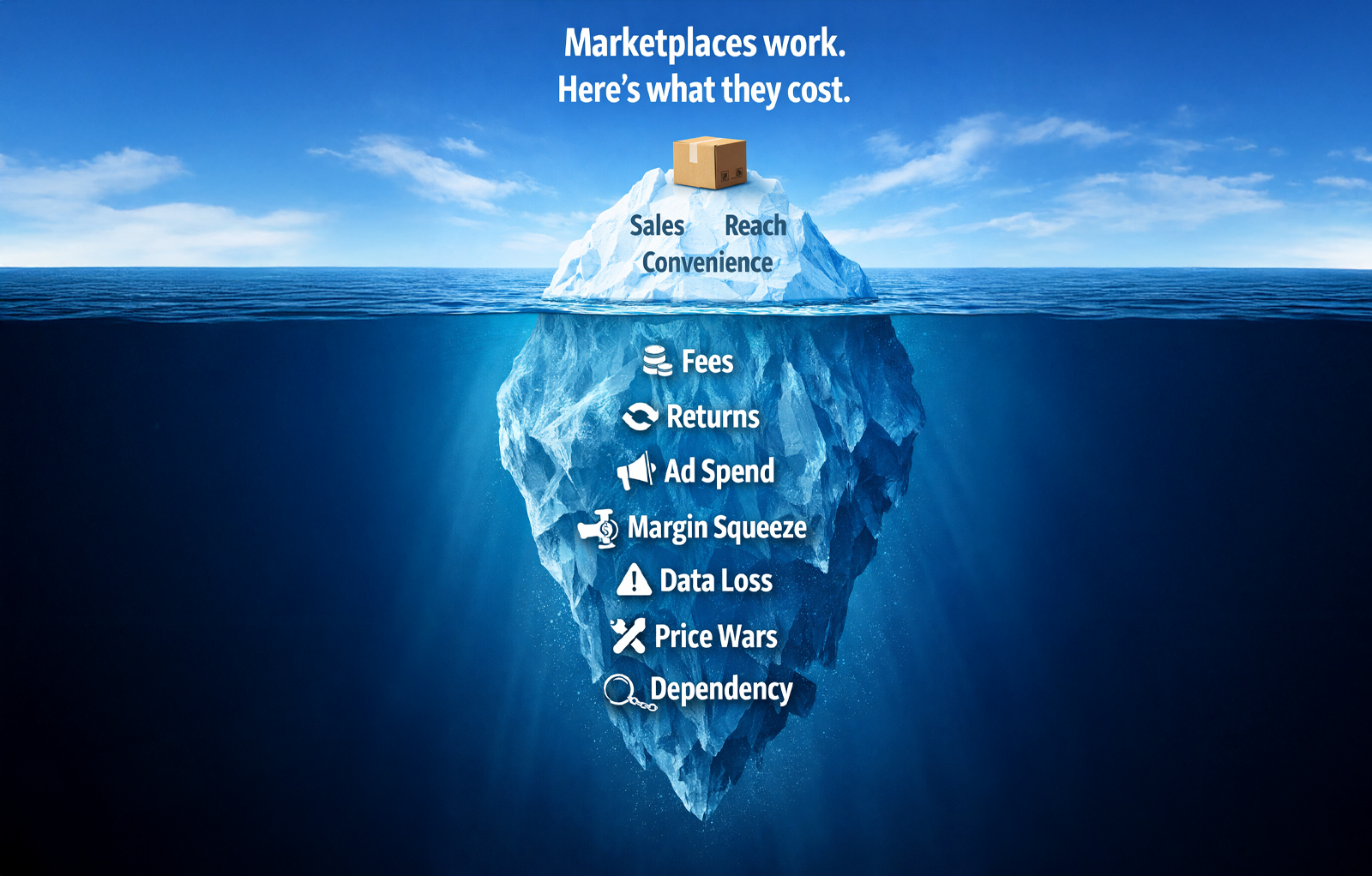
If you’ve ever sat in a meeting where someone says, “We should just get on Amazon”, you’ll know how it goes.
It sounds obvious. Your customers are already there. The traffic is enormous. You can be live quickly. And in a world where attention is expensive, marketplaces feel like a shortcut.
Sometimes they are.
But if marketplaces were simply “a sales channel”, they wouldn’t be as dominant as they are. They’d be interchangeable. They’re not.
Marketplaces work because they solve a very specific problem for customers, and they solve it better than almost anyone else. The catch is that the very things that make them brilliant for customers create the hidden costs for brands.
Let’s unpack both sides properly.
The real reason marketplaces work
Most brands talk about marketplaces as a distribution decision.
Customers experience them as a risk-reduction decision.
When people buy on a marketplace, they’re not just choosing a product. They’re choosing a system.
1) Trust is already built (and you’re borrowing it)
A customer doesn’t wake up trusting a brand they’ve never heard of. They do, however, trust Amazon to deliver the thing they ordered, on time, with a straightforward returns process.
That trust is the real product marketplaces sell.
The marketplace is essentially saying: “You don’t need to do loads of homework. We’ve built the infrastructure, the policies, the payments, the delivery promise, and the social proof. Just pick something.”
That’s why unknown brands can sell at all on marketplaces. They’re borrowing trust.
2) Convenience is not a feature, it’s the point
If you run an independent ecommerce site, you know how many small frictions add up:
- another password
- another checkout flow
- another delivery threshold
- another returns policy
- another “is this site legit?” moment
Marketplaces remove most of that. Saved payment details, familiar UI, reliable delivery options, quick support, predictable returns.
People don’t love marketplaces because they’re exciting. They love them because they are easy.
3) Discovery happens at the moment of intent
Brand websites are great once someone already wants you.
Marketplaces are where people go when they haven’t decided yet.
That is a huge difference.
A marketplace search is usually high intent. “Buy X.” “Best Y.” “Replacement Z.” You’re meeting the customer when they are already in purchase mode, not persuading them to become in purchase mode.
It’s like having your products sitting inside the aisle where the customer has already walked in with a trolley.
4) They compress choice into something manageable
A marketplace can show 5,000 options. That should overwhelm people.
Instead, the algorithm, filters, reviews, badges, delivery promises, and “frequently bought together” widgets do something clever. They take endless choice and turn it into a feeling of confidence.
Customers are not just buying the item. They’re buying the reassurance that they’ve chosen “the normal option” that other people chose and were happy with.
5) The flywheel is real (and brutal)
Marketplaces get stronger because they are already strong:
- more customers attracts more sellers
- more sellers increases selection and pricing competitiveness
- better selection attracts more customers
- more demand attracts more advertising spend
- more ad spend makes the platform even more profitable to improve
This is why marketplaces rarely feel “finished”. They keep getting better at the things customers care about: speed, availability, confidence, simplicity.
If you’re a brand, you can choose to fight that, ignore it, or ride it. But you can’t pretend it isn’t true.
So what’s the hidden cost?
Here’s the bit that catches people out. Most teams can list the obvious fees.
What they underestimate is what they’re giving up in exchange for borrowed trust and convenience.
1) Margin erosion is not just “the fees”
Yes, there are referral fees, fulfilment fees, storage fees, returns processing, and sometimes subscription fees.
But the bigger hit often comes from the second-order costs:
- you’ll likely need marketplace advertising to be visible, especially in competitive categories
- you’ll often need sharper pricing to win the click and the Buy Box
- you’ll have extra operational overhead: content, compliance, inventory rules, case management
- returns rates can be higher, and policies can be less forgiving
The mistake is modelling marketplaces like a normal wholesale account, or like your own D2C channel. It’s neither.
A useful mindset is this: marketplaces are a paid acquisition channel with a fulfilment layer attached.
If you treat it that way, the economics become clearer.
2) You’re renting demand, not building it
When you sell on your own site, every improvement you make compounds:
- better email list
- better customer data
- better repeat purchase
- better conversion rate
- better LTV
- stronger brand recall
On a marketplace, many of those benefits don’t flow back to you in the same way.
You can still build a brand presence, and you should. But you’re largely operating inside somebody else’s relationship with the customer.
That’s why it can feel great in the short term and strangely fragile in the long term.
3) Your brand becomes a line item in a comparison table
On most marketplaces, customers are trained to compare:
- price
- delivery promise
- review score
- number of reviews
- availability
- returns simplicity
That’s it.
Your brand story matters far less unless you deliberately invest in assets that carry it, such as premium imagery, A+ content, video, storefronts, packaging experience, and consistent review quality.
If you don’t, you’re not competing as a brand. You’re competing as a SKU.
And SKU competition tends to turn into price competition.
4) Channel conflict is real, even when nobody admits it
If you have distributors, retailers, or existing wholesale partners, marketplaces can create tension quickly:
- price transparency exposes inconsistencies
- one rogue seller can undermine your whole pricing architecture
- partners see the marketplace as you “going around them”, even if you’re not
- your own D2C site has to justify why it exists if the marketplace is cheaper and faster
This is not a reason to avoid marketplaces. It’s a reason to plan your channel strategy properly before you go live.
5) You inherit platform risk
Marketplaces can change rules, policies, fees, and algorithmic visibility with very little warning.
You can also be hit by:
- listing suppression due to compliance flags
- account health issues
- review manipulation, both positive and negative
- counterfeit or unauthorised resellers
- Buy Box loss due to stock, delivery promise, or pricing parity issues
None of this is theoretical. If you scale on marketplaces, you will encounter some version of it.
That risk is the rent you pay for access to their demand.
6) Operational complexity is usually underestimated
Marketplaces are not “list it and forget it”.
They require:
- content that fits platform rules, not just what looks nice
- constant availability management
- forecasting and replenishment discipline
- performance monitoring at SKU level
- customer service workflows that align to platform expectations
- ongoing ad optimisation, especially if competitors are active
If you do not resource it properly, you get the worst of both worlds: thin margins and inconsistent performance.
The practical question: when do marketplaces make sense?
Marketplaces are brilliant when they are used deliberately, with clear economics and clear intent.
They are dangerous when they are used as a panic button.
Here are the situations where they usually make sense:
Marketplaces tend to work well when:
- your product solves a clear, searchable problem (replacement parts, essentials, functional products)
- you have strong unit economics and can absorb fees and ads
- you can win on availability, delivery promise, or review quality
- you can differentiate with bundles, variations, accessories, or a clearer offer
- you have operational maturity: stock, fulfilment, content, customer service
Marketplaces are harder when:
- you rely on storytelling and nuance to justify your price
- your margins are already tight
- you have heavy returns exposure or fragile items
- you cannot police unauthorised resellers
- your category is dominated by ad-heavy incumbents and you cannot fund visibility
How to avoid the hidden costs
This is the part most people skip. They list products, run ads, see sales, then wonder why profit feels underwhelming and the brand feels weaker.
A few principles make a big difference.
1) Build a marketplace P&L per SKU, not per channel
You want to know, for each product:
- selling price
- cost of goods
- fulfilment and platform fees
- expected ad cost per sale
- expected returns cost
- contribution margin
If the numbers only work in a “perfect world” scenario, they do not work.
2) Decide your role: acquisition, volume, or clearance
Marketplaces can serve different jobs:
- Acquisition: introduce new customers to the brand, then pull them into repeat purchase elsewhere
- Volume: a dependable revenue engine with optimised operations
- Clearance: move end-of-line stock without damaging your core channel
Pick the job. Then build the strategy around that job. Most marketplace pain comes from trying to do all three at once.
3) Design your assortment for the channel
Do not simply mirror your website.
Consider:
- marketplace-only bundles that protect margin
- accessory-led offers that increase basket size
- variations that create a stronger “choice architecture”
- hero SKUs that earn reviews and visibility, then halo the range
4) Protect brand perception deliberately
If you care about brand, invest in the assets that carry it inside the marketplace:
- premium imagery
- clear, benefit-led copy
- A+ content and video where available
- a consistent visual system across listings
- packaging that reinforces trust and quality
The marketplace will not do this for you.
5) Treat advertising as part of the cost of sale
Marketplace ads are not optional in many categories. Budget for them from the start, and judge them against contribution margin, not vanity ROAS.
ROAS can look “good” while profit is quietly disappearing.
The bottom line
Marketplaces work because they reduce customer risk and friction better than any individual brand can.
That’s the magic.
But borrowed trust comes with rent. The rent is margin pressure, reduced customer ownership, platform risk, operational complexity, and a constant pull towards commoditisation.
If you go in with your eyes open, marketplaces can be an incredible growth engine.
If you go in assuming they are just another sales channel, they can quietly become a high-effort, low-margin machine that you can’t turn off.
The aim is not to fear marketplaces. It’s to use them on purpose.
If you want, I can also turn this into:
- a shorter LinkedIn version (with a strong hook and a clean takeaway)
- a one-page “Should we launch on marketplaces?” checklist you can share with prospects
- a simple SKU-level marketplace profit calculator layout you can rebuild in Excel or Sheets
Write the following article: “Vendor vs Seller: how to choose and when to switch” It needs to be warm, engaging and human – avoiding all the typical hallmarks of AI-written content. The article should also position me as an expert and offer real value
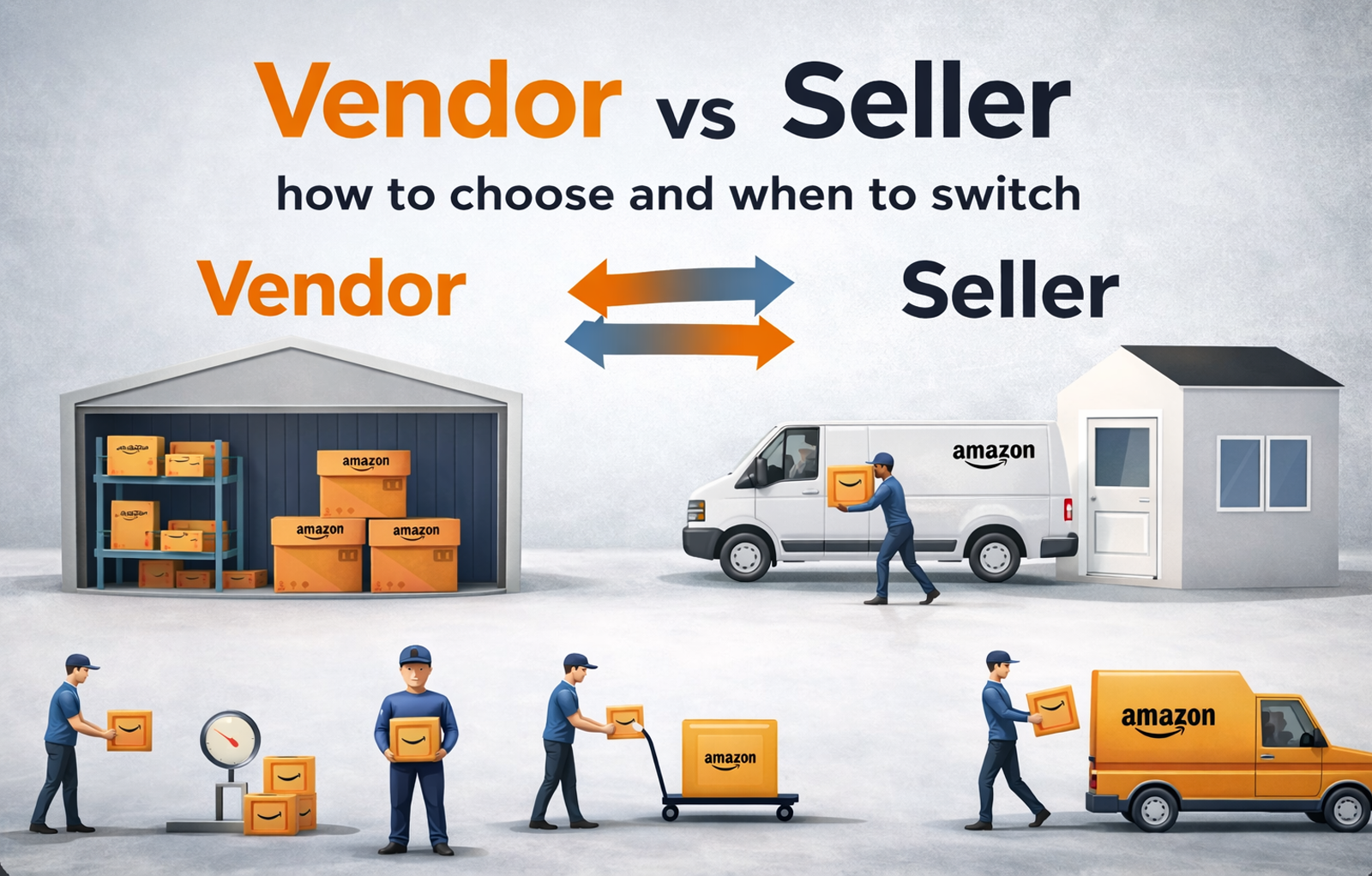
Vendor vs Seller: how to choose and when to switch
If you’ve ever tried to make sense of Amazon’s “Vendor” and “Seller” models, you’ve probably had the same thought most teams do:
Why does this feel needlessly confusing?
Two programmes. Two sets of terminology. Two different fee structures. Two different definitions of “control”. And a whole lot of advice online that boils down to: “Vendor is for big brands. Seller is for everyone else.”
That’s not wrong, but it’s not useful either.
Because in practice, the best choice depends on what you’re optimising for: cash flow, margin, control, speed, brand protection, operational simplicity, or long term resilience. You rarely get to maximise all of them at once.
I’ve managed both models, on both the Vendor and Seller side, and I’ve seen good businesses hurt themselves by choosing the wrong setup for the stage they’re at. This article is the decision framework I wish most people had before they commit.
First: what Vendor and Seller actually mean
Vendor (1P) in plain English
You sell to Amazon like a retailer. Amazon buys your stock at a wholesale price, then Amazon resells it to the customer.
Amazon controls:
- retail pricing (often aggressively)
- promotions (sometimes without asking nicely)
- fulfilment experience (usually great, but you’re not steering it)
- a large chunk of the customer-facing “truth” in the listing
You get:
- large purchase orders when things are going well
- simpler logistics (ship to Amazon, Amazon does the rest)
- less day-to-day customer service load
- often stronger credibility in some categories, especially historically
Seller (3P) in plain English
You sell direct to the customer on Amazon’s marketplace. You own the listing and the retail price, and you either fulfil via FBA or ship yourself.
You control:
- retail pricing (within marketplace rules and competition reality)
- inventory decisions and replenishment strategy
- content and merchandising (more than Vendor, generally)
- your ability to respond quickly and test
You take on:
- more operational complexity
- higher visible fees (referral, fulfilment, storage, etc.)
- more performance management (account health, metrics, cases)
Neither model is “better”. They are optimised for different jobs.
The real trade-off: control vs simplicity
Here’s the most helpful way I’ve found to frame it:
- Vendor is operationally simpler but commercially less controllable
- Seller is commercially controllable but operationally more demanding
That’s the whole game.
The rest is just nuance, and the nuance matters.
Choosing Vendor: when it’s the right move
Vendor tends to be the better fit when you have the scale and predictability to play the “retailer relationship” game.
Vendor is usually a strong choice if:
- Amazon can drive meaningful volume without constant intervention
- Your wholesale margin structure is healthy (you can sell to Amazon profitably even if they discount at retail)
- You want cleaner operations: fewer moving parts, fewer daily fires
- You’re confident in supply and lead times: you can actually fulfil POs consistently
- You can absorb payment terms without it becoming a cash flow chokehold
- Your category naturally behaves like retail (fast-moving, commodity-ish, and Amazon is already a primary destination)
The upside of Vendor (when it works)
Vendor can feel calmer. You’re not living and dying by ad tuning, conversion rate micro-optimisations, or weekly stock coverage anxiety. Amazon places orders, you deliver, they sell.
And for some brands, that predictability is the point.
The risk you need to accept
Vendor works best until it doesn’t. The biggest Vendor risk is waking up one day and realising:
- Amazon has forced retail pricing down
- your margins are quietly thinner than you assumed
- your product is being promoted in ways that pull future demand forward
- and you don’t have an alternative engine to protect you
Vendor can be brilliant, but it can also put you in the passenger seat.
Choosing Seller: when it’s the right move
Seller tends to be the better fit when you care about speed, margin control, and resilience.
Seller is usually a strong choice if:
- You need pricing and margin control (or you’re tired of watching Amazon discount)
- You want to build a repeatable growth engine (ads, content, conversion, reviews, listing optimisation)
- Your range benefits from merchandising (bundles, variations, accessories, upsell logic)
- You’re launching new products and need fast iteration
- You can run good operations: forecasting, replenishment, stock health, and performance metrics
- You want to protect brand positioning more actively
The upside of Seller (when it works)
When Seller is done properly, it becomes a controllable machine:
- you can influence demand with advertising
- you can respond quickly to competitors
- you can protect margin by changing strategy, not just accepting retail realities
- you can build review velocity and listing strength deliberately
Seller is more work, but it gives you levers.
The risk you need to accept
Seller punishes sloppy operations. Stockouts, poor forecasts, weak content, or reactive advertising can turn a profitable range into a mess quickly.
If Vendor is “retail relationship management”, Seller is “retail operations plus performance marketing”.
The part most people miss: the Buy Box and who owns the offer
If you take nothing else from this article, take this.
On Amazon, your business lives or dies based on offer ownership and Buy Box consistency.
- In Vendor, Amazon is usually the offer.
- In Seller, you are the offer (assuming you control authorised sellers and pricing).
If you are Vendor and there are other sellers undercutting, or Amazon is out of stock, you can lose momentum and visibility. If you’re Seller and your own offer is healthy, you can protect continuity far more reliably.
This is one of the most common reasons brands switch.
A simple decision framework
Instead of starting with “Which is better?”, start with “What are we optimising for this year?”
If your priority is:
- Operational simplicity → lean Vendor
- Margin and pricing control → lean Seller
- Speed to launch and test → lean Seller
- Stable volume with less day-to-day work → lean Vendor
- Brand protection and long term resilience → lean Seller
- Cash flow predictability → depends on terms and inventory model, but usually Seller gives more immediate control
Then apply reality checks:
Reality check 1: Can we actually execute Seller properly?
If you cannot maintain stock health, handle cases, run ads, and keep listings clean, Seller will be painful.
Reality check 2: Is Amazon going to treat us like a priority Vendor?
Vendor works best when Amazon wants you. If you’re small, niche, or low volume, you may not get the support you expect. That can lead to slow issue resolution, weak merchandising, and frustrating negotiations.
When to switch: the signs it’s time
Switching models is not a badge of honour. It’s a strategic move. Here are the most common signals.
Signs you should consider switching from Vendor to Seller
- Retail pricing is being driven down and you can’t protect margin
If Amazon’s retail price erodes brand perception and destroys profitability, Seller gives you more levers. - Amazon is inconsistent with inventory, and you’re losing sales due to stockouts
As Seller, you can hold stock and keep the offer live (especially with FBA). - You want to run a more deliberate growth strategy
Vendor can be surprisingly limiting when you want to test bundles, iterate content quickly, or run a performance-led approach. - You’re launching new products and Amazon isn’t prioritising them
Vendor is often slow for NPD unless Amazon is excited about it. - You’re tired of being surprised
If you’re constantly reacting to chargebacks, shortages, co-op discussions, or retail changes you didn’t agree to, Seller can feel more stable.
Signs you should consider switching from Seller to Vendor
Yes, it happens, and sometimes it’s the right call.
- Operational burden is distracting you from core business growth
If your team is stuck firefighting account health, returns, or ads, and you can’t resource it properly, Vendor can simplify. - Your category behaves like pure retail
Some products win primarily on availability, price, and convenience. Vendor can be a smoother model if the numbers work. - Amazon offers a commercially attractive deal
If terms, support, and volume commitments are strong, Vendor can make sense. - You are struggling to win the Buy Box due to multi-seller competition
If you cannot control the seller landscape, Vendor can sometimes stabilise. Sometimes it makes it worse. This needs careful analysis.
How to switch without breaking the business
Switching isn’t as simple as “turn one off, turn the other on”. The danger zone is when you end up with two offers competing against each other, or you lose listing control and your visibility collapses for weeks.
A sensible transition plan usually includes:
1) Build a true SKU-level profit model
Before you move anything, model the economics for the top SKUs:
- fees, fulfilment, ad costs
- expected retail price and conversion
- returns rate assumptions
- inbound shipping and storage impacts
Don’t switch based on hope. Switch based on contribution margin.
2) Decide what the channel is for
Are you switching to:
- protect margin?
- stabilise stock availability?
- unlock faster growth?
- regain control of brand presentation?
Be explicit. It changes your operating plan.
3) Manage offer ownership and seller landscape
This is where most mess happens:
- clean up unauthorised sellers
- address price parity issues
- consider bundles or exclusive SKUs to reduce direct comparability
- align fulfilment method so your offer remains competitive
4) Expect a learning curve and resource accordingly
Seller needs daily attention, especially early. If you move to Seller without assigning a real owner, you will get the downside and miss the upside.
The “best of both” approach (and why it often becomes the worst of both)
Some brands try to run Vendor and Seller in parallel.
Sometimes this is intentional and strategic. Often it’s accidental.
You can do it, but you must be clear which model is primary, otherwise you create:
- internal confusion
- price competition against yourself
- Buy Box instability
- messy inventory allocation
- and a situation where neither channel performs as well as it should
If you want both, design it carefully. For example:
- Vendor for a core replenishment range
- Seller for bundles, NPD, and premium positioning
- clear pricing architecture so you’re not undercutting yourself
The bottom line
Vendor vs Seller isn’t a binary “right answer”. It’s a choice between two operating models.
Vendor is a retailer relationship with simpler operations and less control.
Seller is a direct retail business with more control and more responsibility.
The best decision is the one that matches your stage, your resources, and what you’re actually trying to achieve this year.
If you’re unsure, start here:
- If you want simplicity and can tolerate losing control: Vendor can work.
- If you want control and are willing to run a more hands-on machine: Seller is usually the better long term bet.
And if you’re thinking about switching, don’t ask “Which is better?” Ask:
What problem are we trying to solve, and what will the economics look like per SKU when we solve it?