If you’ve ever sat in a meeting where someone says, “We should just get on Amazon”, you’ll know how it goes.
It sounds obvious. Your customers are already there. The traffic is enormous. You can be live quickly. And in a world where attention is expensive, marketplaces feel like a shortcut.
Sometimes they are.
But if marketplaces were simply “a sales channel”, they wouldn’t be as dominant as they are. They’d be interchangeable. They’re not.
Marketplaces work because they solve a very specific problem for customers, and they solve it better than almost anyone else. The catch is that the very things that make them brilliant for customers create the hidden costs for brands.
Let’s unpack both sides properly.
The real reason marketplaces work
Most brands talk about marketplaces as a distribution decision.
Customers experience them as a risk-reduction decision.
When people buy on a marketplace, they’re not just choosing a product. They’re choosing a system.
1) Trust is already built (and you’re borrowing it)
A customer doesn’t wake up trusting a brand they’ve never heard of. They do, however, trust Amazon to deliver the thing they ordered, on time, with a straightforward returns process.
That trust is the real product marketplaces sell.
The marketplace is essentially saying: “You don’t need to do loads of homework. We’ve built the infrastructure, the policies, the payments, the delivery promise, and the social proof. Just pick something.”
That’s why unknown brands can sell at all on marketplaces. They’re borrowing trust.
2) Convenience is not a feature, it’s the point
If you run an independent ecommerce site, you know how many small frictions add up:
- another password
- another checkout flow
- another delivery threshold
- another returns policy
- another “is this site legit?” moment
Marketplaces remove most of that. Saved payment details, familiar UI, reliable delivery options, quick support, predictable returns.
People don’t love marketplaces because they’re exciting. They love them because they are easy.
3) Discovery happens at the moment of intent
Brand websites are great once someone already wants you.
Marketplaces are where people go when they haven’t decided yet.
That is a huge difference.
A marketplace search is usually high intent. “Buy X.” “Best Y.” “Replacement Z.” You’re meeting the customer when they are already in purchase mode, not persuading them to become in purchase mode.
It’s like having your products sitting inside the aisle where the customer has already walked in with a trolley.
4) They compress choice into something manageable
A marketplace can show 5,000 options. That should overwhelm people.
Instead, the algorithm, filters, reviews, badges, delivery promises, and “frequently bought together” widgets do something clever. They take endless choice and turn it into a feeling of confidence.
Customers are not just buying the item. They’re buying the reassurance that they’ve chosen “the normal option” that other people chose and were happy with.
5) The flywheel is real (and brutal)
Marketplaces get stronger because they are already strong:
- more customers attracts more sellers
- more sellers increases selection and pricing competitiveness
- better selection attracts more customers
- more demand attracts more advertising spend
- more ad spend makes the platform even more profitable to improve
This is why marketplaces rarely feel “finished”. They keep getting better at the things customers care about: speed, availability, confidence, simplicity.
If you’re a brand, you can choose to fight that, ignore it, or ride it. But you can’t pretend it isn’t true.
So what’s the hidden cost?
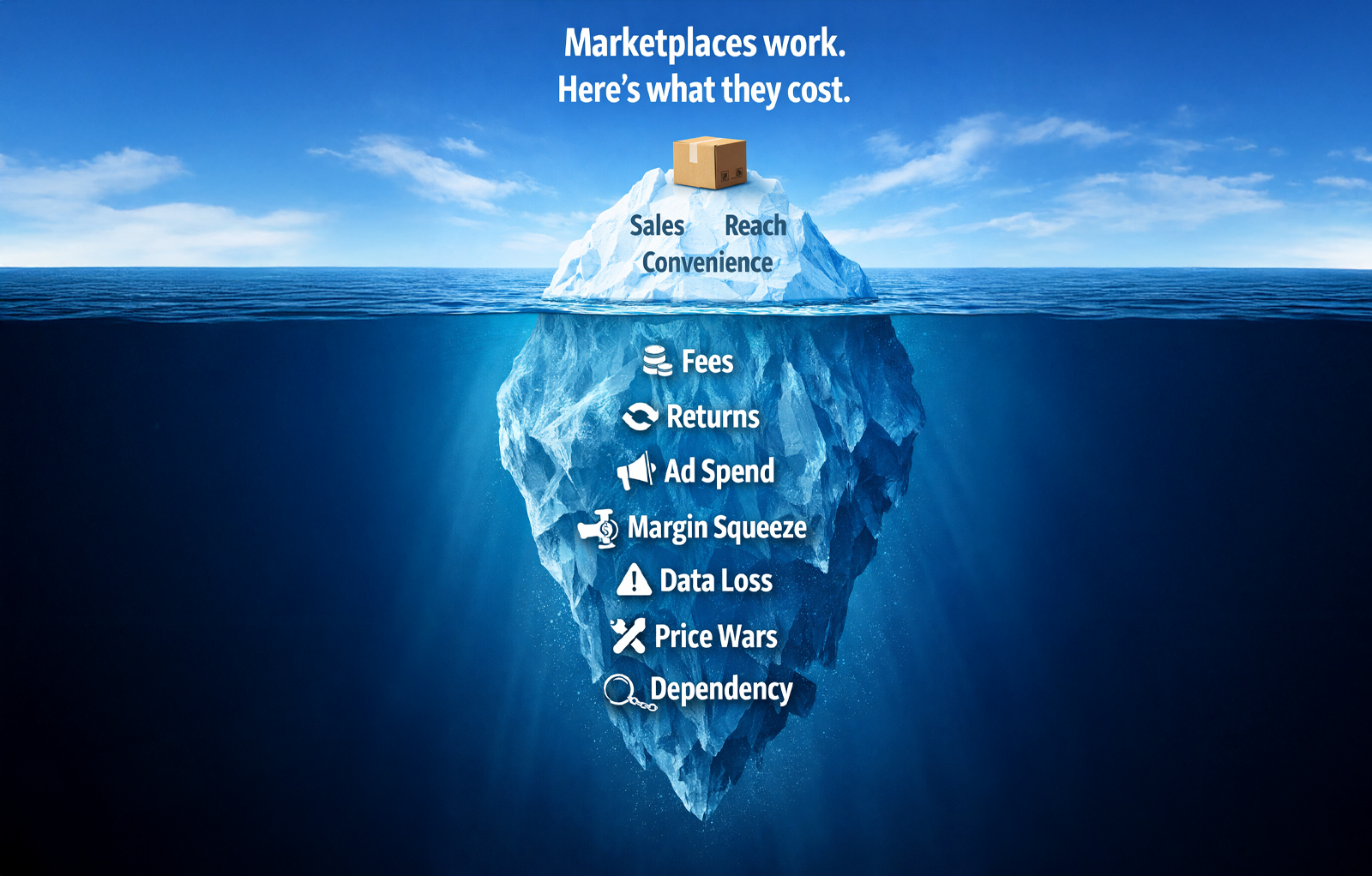
Here’s the bit that catches people out. Most teams can list the obvious fees.
What they underestimate is what they’re giving up in exchange for borrowed trust and convenience.
1) Margin erosion is not just “the fees”
Yes, there are referral fees, fulfilment fees, storage fees, returns processing, and sometimes subscription fees.
But the bigger hit often comes from the second-order costs:
- you’ll likely need marketplace advertising to be visible, especially in competitive categories
- you’ll often need sharper pricing to win the click and the Buy Box
- you’ll have extra operational overhead: content, compliance, inventory rules, case management
- returns rates can be higher, and policies can be less forgiving
The mistake is modelling marketplaces like a normal wholesale account, or like your own D2C channel. It’s neither.
A useful mindset is this: marketplaces are a paid acquisition channel with a fulfilment layer attached.
If you treat it that way, the economics become clearer.
2) You’re renting demand, not building it
When you sell on your own site, every improvement you make compounds:
- better email list
- better customer data
- better repeat purchase
- better conversion rate
- better LTV
- stronger brand recall
On a marketplace, many of those benefits don’t flow back to you in the same way.
You can still build a brand presence, and you should. But you’re largely operating inside somebody else’s relationship with the customer.
That’s why it can feel great in the short term and strangely fragile in the long term.
3) Your brand becomes a line item in a comparison table
On most marketplaces, customers are trained to compare:
- price
- delivery promise
- review score
- number of reviews
- availability
- returns simplicity
That’s it.
Your brand story matters far less unless you deliberately invest in assets that carry it, such as premium imagery, A+ content, video, storefronts, packaging experience, and consistent review quality.
If you don’t, you’re not competing as a brand. You’re competing as a SKU.
And SKU competition tends to turn into price competition.
4) Channel conflict is real, even when nobody admits it
If you have distributors, retailers, or existing wholesale partners, marketplaces can create tension quickly:
- price transparency exposes inconsistencies
- one rogue seller can undermine your whole pricing architecture
- partners see the marketplace as you “going around them”, even if you’re not
- your own D2C site has to justify why it exists if the marketplace is cheaper and faster
This is not a reason to avoid marketplaces. It’s a reason to plan your channel strategy properly before you go live.
5) You inherit platform risk
Marketplaces can change rules, policies, fees, and algorithmic visibility with very little warning.
You can also be hit by:
- listing suppression due to compliance flags
- account health issues
- review manipulation, both positive and negative
- counterfeit or unauthorised resellers
- Buy Box loss due to stock, delivery promise, or pricing parity issues
None of this is theoretical. If you scale on marketplaces, you will encounter some version of it.
That risk is the rent you pay for access to their demand.
6) Operational complexity is usually underestimated
Marketplaces are not “list it and forget it”.
They require:
- content that fits platform rules, not just what looks nice
- constant availability management
- forecasting and replenishment discipline
- performance monitoring at SKU level
- customer service workflows that align to platform expectations
- ongoing ad optimisation, especially if competitors are active
If you do not resource it properly, you get the worst of both worlds: thin margins and inconsistent performance.
The practical question: when do marketplaces make sense?
Marketplaces are brilliant when they are used deliberately, with clear economics and clear intent.
They are dangerous when they are used as a panic button.
Here are the situations where they usually make sense:
Marketplaces tend to work well when:
- your product solves a clear, searchable problem (replacement parts, essentials, functional products)
- you have strong unit economics and can absorb fees and ads
- you can win on availability, delivery promise, or review quality
- you can differentiate with bundles, variations, accessories, or a clearer offer
- you have operational maturity: stock, fulfilment, content, customer service
Marketplaces are harder when:
- you rely on storytelling and nuance to justify your price
- your margins are already tight
- you have heavy returns exposure or fragile items
- you cannot police unauthorised resellers
- your category is dominated by ad-heavy incumbents and you cannot fund visibility
How to avoid the hidden costs
This is the part most people skip. They list products, run ads, see sales, then wonder why profit feels underwhelming and the brand feels weaker.
A few principles make a big difference.
1) Build a marketplace P&L per SKU, not per channel
You want to know, for each product:
- selling price
- cost of goods
- fulfilment and platform fees
- expected ad cost per sale
- expected returns cost
- contribution margin
If the numbers only work in a “perfect world” scenario, they do not work.
2) Decide your role: acquisition, volume, or clearance
Marketplaces can serve different jobs:
- Acquisition: introduce new customers to the brand, then pull them into repeat purchase elsewhere
- Volume: a dependable revenue engine with optimised operations
- Clearance: move end-of-line stock without damaging your core channel
Pick the job. Then build the strategy around that job. Most marketplace pain comes from trying to do all three at once.
3) Design your assortment for the channel
Do not simply mirror your website.
Consider:
- marketplace-only bundles that protect margin
- accessory-led offers that increase basket size
- variations that create a stronger “choice architecture”
- hero SKUs that earn reviews and visibility, then halo the range
4) Protect brand perception deliberately
If you care about brand, invest in the assets that carry it inside the marketplace:
- premium imagery
- clear, benefit-led copy
- A+ content and video where available
- a consistent visual system across listings
- packaging that reinforces trust and quality
The marketplace will not do this for you.
5) Treat advertising as part of the cost of sale
Marketplace ads are not optional in many categories. Budget for them from the start, and judge them against contribution margin, not vanity ROAS.
ROAS can look “good” while profit is quietly disappearing.
The bottom line
Marketplaces work because they reduce customer risk and friction better than any individual brand can.
That’s the magic.
But borrowed trust comes with rent. The rent is margin pressure, reduced customer ownership, platform risk, operational complexity, and a constant pull towards commoditisation.
If you go in with your eyes open, marketplaces can be an incredible growth engine.
If you go in assuming they are just another sales channel, they can quietly become a high-effort, low-margin machine that you can’t turn off.
The aim is not to fear marketplaces. It’s to use them on purpose.
Leave a Reply