Category: B2B to D2C

  • The Quick and Dirty Guide to Adding a D2C Channel

    The Quick and Dirty Guide to Adding a D2C Channel

    Not everyone needs a 6-month strategy project to find out whether D2C has legs for your business. What you do need is a focused, low-risk way to get in the game, learn fast, and avoid upsetting your existing channels in the process.

    Here’s the quick and dirty version – a condensed, practical guide you can actually execute.


    1. Decide which products will perform well in D2C

    Not everything you sell is a good fit for D2C.

    Look for products that are:

    • Easy to ship – not insanely heavy, fragile or oversized
    • Easy to understand – customers can “get it” from photos, video and copy
    • High enough margin – room to absorb marketing and fulfilment costs
    • Naturally “searchable” or “scroll-stopping” – people either look for them or they look good in a feed

    Start with:

    • 5–20 SKUs, not your entire catalogue
    • Products that already perform well and have good feedback
    • A mix of hero products (to attract customers) and add-ons (to boost AOV)

    Avoid:

    • Ultra-bespoke items needing lots of back-and-forth
    • Low-margin commodities where you’ll be fighting on price from day one

    Quick and dirty rule: If you can’t explain what it is, who it’s for, and why it’s great in 1–2 sentences, it’s probably not your first D2C product.


    2. Define a simple order and fulfilment process

    Before you build anything, answer: “What happens after someone clicks ‘Buy’?”

    Map it very simply:

    1. Customer places order on the site
    2. Order appears in [platform / email / dashboard]
    3. [Warehouse / 3PL / person] picks, packs and ships
    4. Tracking is sent to the customer
    5. Returns are handled by [process]

    Make decisions on:

    • Where will stock live?
      • In your main warehouse?
      • With a 3PL?
      • In a small ring-fenced area with clear labelling?
    • Who will actually pick and pack?
      • Existing staff?
      • A specific person or shift?
      • A partner?
    • What’s your delivery promise?
      • Standard 2–3 working days to start
      • One express option if you can reliably meet it
    • How will returns work?
      • Clear instructions in the parcel
      • A fixed return address
      • A simple policy (e.g. “30 days, unused, full refund”)

    Don’t aim for next-day cut-offs, complex delivery matrices or a fully automated returns portal on day one. Make it simple, consistent and reliable first.


    3. Pick an ecommerce platform (and don’t overthink it)

    For most B2B brands going D2C, Shopify is a perfectly good starting point:

    • Fast to set up
    • Mature ecosystem of apps
    • Plenty of agencies and freelancers who know it
    • Handles hosting, security and updates for you

    Your v1 requirements:

    • Clean product pages
    • Simple checkout
    • Basic discount codes
    • Integration with your chosen payment methods
    • Basic shipping rules

    You do not need:

    • A bespoke, custom-built platform
    • Full headless architecture
    • Complex multi-store, multi-language, multi-currency setup if you’re only serving one core market at launch

    Quick and dirty rule: If your platform conversations are taking longer than it would take to set up a basic Shopify store and sell one product, you’re overcomplicating it.


    4. Choose a single target market and a focused marketing stack

    “Everyone” is not your first D2C audience.

    Pick one:

    • A country (e.g. UK only to start)
    • A customer type (e.g. serious hobbyists, small workshops, home DIYers)
    • A clear problem or use case (e.g. “people who want X done faster / cleaner / cheaper”)

    Then pick one primary channel and one primary ad platform to reach them:

    • If your product is visual / lifestyle →
      • Channel: Instagram or TikTok
      • Ad platform: Meta Ads (Facebook & Instagram)
    • If your product solves an urgent, “searchable” problem →
      • Channel: Google (search and shopping)
      • Ad platform: Google Ads
    • If you already have an email list or strong organic presence →
      • Channel: Email + website
      • Ad platform: Use paid only to top up traffic

    Don’t try to master five channels at once. You want a tight loop:

    Traffic → Product page → Checkout → Email capture → Follow-up

    Quick and dirty rule: One market, one main traffic source, one main ad platform for the first 3–6 months.


    5. Set up basic email and reviews from day one

    Two things you should not skip:

    Email / CRM

    At minimum, set up:

    • A welcome flow for new subscribers (“Here’s who we are, here’s what we do best”)
    • A post-purchase flow:
      • Order confirmation
      • Shipping confirmation
      • Product education (“How to get the best results”)
      • Review request

    Use email to:

    • Nudge second purchases
    • Cross-sell related products
    • Share helpful content that builds trust

    Reviews

    Turn on reviews from the first sale:

    • Ask for a review 7–10 days after delivery
    • Display them clearly on product pages
    • Pay attention to what customers actually say – it’s gold for improving your copy and offers

    These two elements are your foundation for repeat purchase and social proof, which are the difference between “D2C as a one-off experiment” and “D2C as a channel that compounds”.


    6. Test with a small sample before you roll out the full range

    Resist the urge to dump your entire catalogue onto the site straight away.

    Instead:

    1. Launch with your small, carefully chosen product set
    2. Drive traffic with your chosen channel and ad platform
    3. Watch the basics:
      • Click-through rate (CTR)
      • Add-to-basket rate
      • Conversion rate
      • Average order value (AOV)
      • Cost per acquisition (CAC)
    4. Fix obvious friction first:
      • Are customers confused by the product?
      • Are there questions your product pages aren’t answering?
      • Is shipping too expensive or too slow?
    5. Once you’ve:
      • Proven you can acquire customers at a semi-sensible cost
      • Delivered reliably
      • Got your first batch of positive reviews

    …then add more products in structured waves (e.g. by category, use case or price point).

    Quick and dirty rule: If you can’t make 10–20 products sell profitably, you’re not ready to put 200 on the site.


    7. Decide in advance what “good” looks like

    Before you start, define a few simple success criteria, for example:

    • Target conversion rate (e.g. 1.5–3% depending on price point)
    • Target AOV (what you need for the maths to work)
    • Maximum acceptable CAC for first orders
    • Desired repeat purchase rate over 6–12 months

    You don’t need perfect numbers, but you do need boundaries. That way, you can say:

    • “This is worth scaling.”
    • Or, “This needs fixing before we throw more money at it.”
    • Or, “This is not viable in the current form.”

    Without this, you’ll end up with a vague feeling that “D2C is kind of working / kind of not”, which helps no one.


    8. The ultra-condensed checklist

    If you just want the bullet points, here they are:

    1. Pick the right products – high margin, easy to ship, easy to understand, visually or functionally compelling.
    2. Map the order flow – who picks, packs, ships and handles returns, with simple, realistic promises.
    3. Choose a sensible platform – Shopify (or similar) with a clean theme and only essential apps.
    4. Focus your marketing – one target market, one primary channel, one main ad platform.
    5. Turn on email and reviews – welcome flow, post-purchase flow, review requests.
    6. Start small – limited range, limited budget, tight feedback loop.
    7. Know your numbers – AOV, CAC, conversion, contribution, repeat rate.
    8. Iterate before you scale – fix friction, prove viability, then expand.

    That’s it. Not a 50-page strategy deck. Not a multi-year transformation programme.

    Just a realistic, quick and dirty way to get into D2C, learn fast, and prove whether it deserves a permanent place in your channel mix.
  • Aligning Your Organisation for D2C: Getting Sales, Marketing, Ops and Finance on the Same Page

    Aligning Your Organisation for D2C: Getting Sales, Marketing, Ops and Finance on the Same Page

    Adding a D2C channel isn’t just a marketing project.

    It touches how you sell, how you serve customers, how you plan stock, how you recognise revenue, and how you manage channel relationships. If you treat D2C as “just another website”, you’ll quickly run into internal resistance:

    • Sales worry you’re stealing their accounts
    • Ops see extra complexity with no extra resource
    • Finance sees risk, unclear margins and moving targets
    • Marketing feels responsible for everything, but owns very little in reality

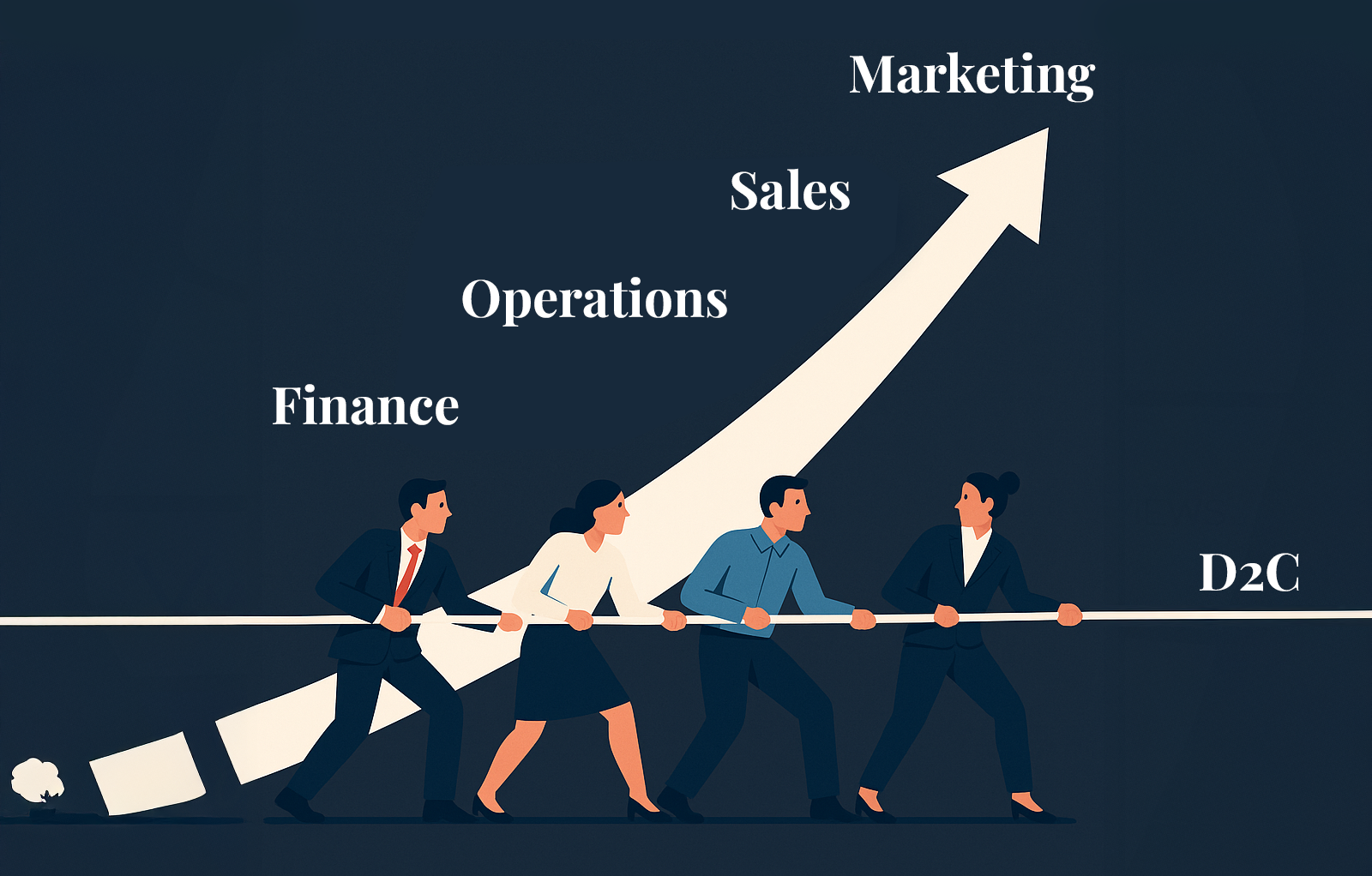
    The brands that make D2C work don’t just pick the right tech or launch a nice-looking site. They align the organisation around what D2C is for, how it will be measured, and who is accountable for what.

    Here’s how to get sales, marketing, operations and finance on the same page before you flip the switch.


    1. Start with a clear, shared purpose for D2C

    Most internal conflict comes from fuzzy intent.

    If sales thinks D2C is there to replace distributors…
    If marketing thinks it’s a brand playground…
    If finance thinks it’s a margin-fix…
    If ops thinks it’s “more work for us”…

    …you’re going to spend months firefighting politics.

    You need a simple, shared statement of purpose. For example:

    “Our D2C channel exists to deepen our relationship with end customers, act as a test lab for innovation, and provide a complementary route to market that supports – not replaces – our trade partners.”

    Or:

    “Our D2C channel exists to serve niche and long-tail demand, build a direct data asset, and prove concepts before scaling them with retailers and distributors.”

    This isn’t just marketing copy. It’s the anchor you use in:

    • Board updates
    • Sales team briefings
    • Ops planning
    • Budget discussions

    Once everyone agrees why D2C exists, the “how” becomes much easier to negotiate.


    2. Bring sales in early (or live with resistance later)

    If your field sales or account management team find out about D2C via LinkedIn or a customer email, you’ve already lost.

    Their first thoughts will be:

    • “Will this hit my numbers?”
    • “What am I supposed to say if a customer complains?”
    • “Are they quietly replacing me with a website?”

    You can avoid a lot of drama by:

    Involving them in the design

    • Share the D2C purpose and how it fits in the channel mix
    • Ask for their input on:
      • Which products would cause conflict if sold D2C
      • Which customers are most likely to react strongly
      • What support they’d need to have confident conversations

    Clarifying how commissions and targets work

    Nothing undermines trust faster than messing with people’s pay.

    Consider:

    • Will sales still get recognised when “their” customers buy direct?
    • Do you ring-fence certain accounts as “trade only”?
    • Do you protect some territories from outbound D2C marketing?

    You don’t need a perfect solution immediately, but you do need something that feels fair and is communicated clearly.

    Equipping them with a narrative

    Give sales simple, honest language they can use:

    • Why you’re adding D2C
    • What you will and won’t do (pricing, promotions, range)
    • How it benefits their customers (better content, support, long-tail products)
    • How it benefits them (warmer leads, proven propositions, better assets)

    If your sales team understands that D2C is there to support their relationships – not quietly eat them – they’re far more likely to help than hinder.


    3. Give marketing ownership without dumping everything on them

    Marketing is usually the natural home for D2C – but that doesn’t mean they can or should do everything.

    You’ll need clearly defined responsibilities across:

    • Trading / merchandising – what you sell, how you present it, what you promote
    • Performance marketing – how you acquire traffic and customers
    • Brand & content – how the site looks, feels and communicates
    • CRM & retention – how you keep customers engaged between purchases

    Agree:

    • Who owns the commercial performance of the channel (revenue, margin, ROAS)?
    • Who has the authority to change prices, run promotions and adjust the range?
    • Which decisions require wider sign-off (e.g. discounts that might upset key accounts)?

    Marketing can lead, but they need:

    • Data from finance
    • Operational constraints from ops
    • Real-world feedback from sales

    D2C performance reviews should be cross-functional by default. If marketing is presenting results “into the void” without sales, ops and finance in the room, you’re missing the point.


    4. Get operations in the room before you promise anything

    From an ops perspective, D2C is a different sport:

    • Smaller, more frequent orders
    • Different packaging and labelling standards
    • Increased customer service load
    • Returns from consumers, not pallets and trade customers

    If you design D2C in isolation and then “hand it” to operations, you’ll get understandable pushback:

    • “We can’t meet that cut-off time with current staffing.”
    • “We don’t have space for that kind of packaging.”
    • “Those delivery promises aren’t realistic from this warehouse.”

    So:

    • Bring ops into the conversation early – at concept stage, not a week before launch
    • Ask them:
      • What service levels can we confidently deliver today?
      • What changes would we need to make for next-day or same-day?
      • How will D2C pick/pack fit into existing workflows?

    Design your proposition around operational reality, not in spite of it.

    And crucially, don’t forget customer service:

    • Who answers pre-purchase questions?
    • Who handles “where is my order?” queries?
    • What hours are you actually available?

    If you expect customer service and warehouse teams to take on more work, they need:

    • Resource
    • Training
    • A clear sense of why the business is doing this

    5. Let finance set guardrails, not roadblocks

    Finance’s job isn’t to say no. It’s to make sure you don’t launch a channel that quietly leaks cash.

    Involving finance early helps you:

    • Build a realistic D2C P&L
    • Agree what “good” looks like in numbers
    • Set boundaries for experimentation

    Work with them to define:

    Core metrics and thresholds

    • Acceptable CAC (customer acquisition cost)
    • Minimum contribution margin per order
    • Target return on ad spend (ROAS) or marketing efficiency ratio
    • Payback period on acquisition (e.g. break even on order 1 or within 3 months)

    Investment expectations

    • Upfront setup (platform, design, integrations)
    • Ongoing opex (media, people, fulfilment, tech)
    • How long you’re willing to invest before judging success

    Reporting rhythm

    • Monthly D2C performance pack
    • Quarterly deep dives into LTV, cohort behaviour and unit economics
    • Clear triggers for scaling up (or pulling back)

    When finance understands the logic and levers of D2C, they’re far more likely to back you – and far less likely to panic at the first dip in performance.


    6. Agree shared KPIs and a simple governance model

    D2C will fail if each function has conflicting success measures.

    For example:

    • Sales judged purely on trade revenue
    • Marketing judged on D2C top-line growth
    • Finance focused only on short-term profitability
    • Ops focused on volume and efficiency

    You get politics, not progress.

    Instead, define a small set of shared KPIs, such as:

    • D2C revenue and margin
    • Contribution after marketing and fulfilment
    • New customers acquired and repeat purchase rate
    • Customer satisfaction (NPS/CSAT, reviews, returns)

    Then:

    • Make these visible to all relevant teams
    • Discuss them together in a regular D2C trading / steering meeting
    • Use them to guide decisions, not just report history

    On governance, you don’t need a 40-page document. You do need:

    • A cross-functional D2C owner or steering group
    • A clear cadence:
      • Weekly trading stand-up (tactical changes, quick wins)
      • Monthly performance review (deeper analysis, plan adjustments)
      • Quarterly strategy review (bigger bets, investment decisions)

    And you need to be explicit about:

    • What marketing can decide alone
    • What requires input from sales / ops / finance
    • What goes to the exec team or board

    Governance is about speed and alignment – not endless approvals.


    7. Communicate internally like you would externally

    Many D2C launches fail because the internal communication is worse than the external marketing.

    Treat your colleagues like a critical audience:

    • Explain the purpose and plan simply
    • Share mock-ups and journeys so people can see what’s coming
    • Run internal demos of the site before go-live
    • Create a short internal FAQ:
      • Why are we doing this?
      • What does it mean for my team?
      • How will we handle pricing, promotions, and key accounts?
      • Who do I talk to if I see a problem or have an idea?

    Share early wins:

    • First orders
    • First positive reviews
    • First “test and learn” insights that help trade channels

    This changes the story from “extra work and risk” to “a project that’s starting to pay off”.


    8. A quick organisational readiness checklist

    You’re in a good place to align the organisation around D2C if you can say:

    • We have a clear, shared statement of D2C’s purpose in our channel mix
    • Sales have been informed, consulted and equipped with a fair story and commission logic
    • Marketing has clear ownership of D2C performance, but isn’t expected to do everything in a vacuum
    • Ops (including customer service) have been involved in defining realistic service levels
    • Finance has helped model the economics and set sensible guardrails
    • We’ve agreed shared KPIs and a basic governance / decision-making framework
    • We have a communication plan for both internal teams and external partners

    If a few of these are missing, your first job isn’t “build the site”. It’s to align the people who will make – or break – the channel.


    Adding D2C is as much an organisational change project as it is a commercial or technical one.

    Get sales, marketing, ops and finance genuinely pulling in the same direction, and your chances of success go up dramatically. Ignore the internal piece, and you’ll spend most of your time managing friction instead of customers.

    The technology can always be upgraded.

    The relationships, trust and shared understanding across your teams? Those are the real foundations your D2C channel will stand on.

  • Building a D2C Tech Stack for B2B Brands: What You Actually Need (and What You Don’t)

    Building a D2C Tech Stack for B2B Brands: What You Actually Need (and What You Don’t)

    One of the fastest ways to derail a D2C project is to let the tech drive the strategy.

    You’ve probably heard some version of this:

    “We need a headless, composable, MACH-based, ultra-future-proof tech stack before we sell our first product.”

    Meanwhile, your board just wants to know: “Can we sell directly to customers without breaking everything or spending a fortune?”

    If you’re a B2B manufacturer or distributor adding a D2C channel, you don’t need a Silicon Valley-grade ecommerce stack on day one. You need something robust, sensible, and scalable – that gets you trading, learning and improving quickly.

    Let’s be clear about what you actually need… and what you really don’t.


    1. Start with the “minimum viable stack”

    Think of your tech stack in three layers:

    1. Sell – the ecommerce platform and checkout
    2. Operate – stock, orders, fulfilment, payments, tax
    3. Grow – marketing, data, optimisation

    For a typical B2B brand going D2C, your minimum viable stack usually looks like this:

    • Ecommerce platform – e.g. Shopify (or similar)
    • Payments – card + digital wallets (Apple/Google Pay, PayPal, etc.)
    • Basic logistics – shipping integrations and label printing
    • Email & CRM – to capture data and start building relationships
    • Reviews – to build trust quickly
    • Analytics – for traffic, funnels and basic ecommerce reporting

    If you can:

    • Take an order
    • Take payment
    • Ship reliably
    • Email that customer again

    …you’re in the game. Everything else is refinement.


    2. Choosing your ecommerce platform: don’t overcomplicate it

    Most B2B businesses moving into D2C don’t need a fully custom-built platform.

    You’re usually better off with:

    • A modern SaaS platform (e.g. Shopify, BigCommerce)
    • Lightweight customisation
    • A focus on UX, performance and reliability

    Why?

    • Hosting, security and updates are handled for you
    • There’s a mature ecosystem of apps and integrations
    • You don’t tie yourself to an internal IT bottleneck

    On day one, you don’t need:

    • A bespoke, from-scratch build
    • Full headless architecture “just in case”
    • Complex multi-store, multi-region setups if you’re only truly ready to serve one or two core markets

    Could you move to something more complex later? Of course. But it’s far easier to upgrade from a functioning, profitable store than it is to rescue an over-engineered project that’s burned time and budget without selling anything.


    3. Integrations with ERP, stock and pricing: be pragmatic

    This is where many B2B → D2C projects get stuck: “We can’t go live until everything is fully integrated with the ERP.”

    Integration is important. But waiting for perfect integration can delay launch by months, if not years.

    Ask two questions:

    1. What absolutely must be automated from day one?
      • Stock availability that’s accurate enough not to oversell catastrophically
      • Orders flowing into your existing processes (or at least a manageable manual workaround)
    2. What can be manual or semi-manual for version one?
      • Occasional stock level syncs (daily, not real-time)
      • Manual pricing updates if you only have a modest catalogue
      • Exporting orders into your ERP in batches while volume is low

    The goal is to balance:

    • Risk (overselling, poor customer experience)
    • Complexity (months of integration work before you’ve learned anything)

    For many brands, a sensible route is:

    • Phase 1: Light-touch integration + some manual processes
    • Phase 2: Deeper integration once you have real data and D2C revenue to justify the investment

    4. Payments and checkout: optimise for trust and convenience

    You don’t need every possible payment method, but you do need the ones your customers expect.

    At a minimum:

    • Major debit/credit cards
    • Apple Pay / Google Pay
    • PayPal or a similar digital wallet

    These improve conversion, especially on mobile.

    Things you probably don’t need on day one:

    • Buy now, pay later (unless it’s standard in your category)
    • Every niche local payment method under the sun
    • Complex credit / account terms online (keep this in the B2B channel to begin with)

    Your priorities at launch:

    • A clean, simple checkout with as few fields as possible
    • Clear delivery options and costs
    • Obvious trust markers (SSL, reviews, clear returns policy)

    Get those right and you can add further payment methods later, based on what customers actually ask for.


    5. Logistics and fulfilment: simple beats clever

    D2C fulfilment has a nasty habit of becoming overcomplicated.

    You have two basic options:

    1. Use your own warehouse
      • Pros: more control, uses existing stock, closer to operations
      • Cons: your processes are probably built for cartons and pallets, not single units and gift notes
    2. Use a third-party logistics provider (3PL)
      • Pros: they already understand D2C, scalable, often easier to integrate
      • Cons: less direct control, another relationship to manage, per-order fees

    Whichever you choose, your tech stack needs to:

    • Feed orders into the warehouse/3PL
    • Print labels and manage tracking
    • Update customers with shipping and delivery information

    You do not need:

    • Hyper-optimised multi-warehouse routing from day one
    • An over-engineered returns portal, if your volume will be modest initially
    • Twelve delivery options that confuse customers and your operations team

    Start with:

    • 1–3 clear delivery options (e.g. standard, express, free over £X)
    • A simple, customer-friendly returns process
    • Tracking links that actually work

    You can worry about same-day cut-off messaging and complex delivery rules when you’re shipping enough volume for it to matter.


    6. Email, CRM and reviews: the “growth stack” essentials

    D2C without data is just a slightly shinier form of wholesale.

    From day one, you should be:

    • Capturing customer details
    • Sending useful, relevant emails
    • Collecting reviews

    At minimum, your stack should support:

    • Welcome flows – emails for new subscribers/customers that introduce your brand and nudge first or second purchase
    • Post-purchase flows – order confirmations, shipping updates, product education and review requests
    • Basic segmentation – at least “new vs returning” and “purchased X category”

    This doesn’t require enterprise-grade marketing automation. A good email platform integrated with your store will do.

    Reviews are equally important:

    • Social proof boosts conversion
    • Feedback helps you refine product and messaging
    • You generate content that can be reused in trade channels too

    Start with:

    • Automatic review requests a set period after delivery
    • On-site review display
    • The option to respond to and learn from customer comments

    You can add clever segmentation, advanced personalisation and loyalty programmes later. First, prove that you can drive repeat purchase with simple, well-executed fundamentals.


    7. Analytics: know what’s happening, not every possible thing

    You want enough data to make decisions – not so much that you drown in dashboards.

    Your initial analytics setup should tell you:

    • Where your traffic is coming from
    • Which channels drive new customers vs window-shoppers
    • How your funnel performs (sessions → add to basket → checkout → purchase)
    • Which products generate the most revenue, margin and repeat purchase

    Start with:

    • Your platform’s own analytics
    • A mainstream analytics tool for traffic and behaviour
    • Clear, simple reports you actually look at every week

    You do not need:

    • A full-blown data warehouse
    • Custom attribution models before you’re even certain which channels you’ll use long-term
    • An army of dashboards no-one understands

    The rule is simple: if a report doesn’t influence a decision, you don’t need it yet.


    8. Nice-to-haves (for later)

    As your D2C channel matures, there are tools that can add real value – but they’re not essential at launch. For example:

    • On-site search and merchandising tools – to refine PLP and search performance once you have meaningful traffic
    • Personalisation engines – to tailor content and offers at scale
    • Loyalty and referral platforms – once you’ve nailed your basic repeat purchase levers
    • CDPs and advanced segmentation – when you’re dealing with multiple channels and large datasets
    • Headless / composable architecture – if your requirements outgrow what a standard platform can reasonably handle

    Treat these as phase two and three upgrades – driven by specific needs, not by fear of “falling behind”.


    9. A simple test: are you over-engineering this?

    You’re probably overcomplicating your D2C tech stack if:

    • You’ve spent more time in architecture diagrams than talking to customers
    • Every conversation starts with “integration” and rarely with “experience”
    • You’re planning to go live “next year” and no-one can say exactly when
    • Your team is exhausted – and you haven’t sold a single product yet

    You’re in a good place if:

    • You can go from idea to live order in months, not years
    • Everyone understands what each piece of the stack is for
    • You’re already planning how to test, learn and improve – not just how to launch

    A D2C channel lives or dies not on how fancy the tech is, but on whether it helps you sell, serve and learn from customers.

    Start with a minimum viable stack that’s good enough, reliable and simple to run. Launch something real. Use it to prove demand, refine your proposition and justify further investment.

    You can always make your tech stack more sophisticated.

    What’s harder to recover is the time and trust lost if you chase “future-proof perfection” and never quite get to the part where customers can actually buy from you.

  • Using D2C as a Test Lab: How to De-Risk Innovation for Your Retail and Distribution Partners

    Using D2C as a Test Lab: How to De-Risk Innovation for Your Retail and Distribution Partners

    Most B2B brands think about D2C in terms of revenue.

    “Can we add another sales channel?”
    “Can we improve our margin?”
    “Can we grow faster?”

    Those are valid questions, but they miss one of the most powerful strategic benefits of D2C:

    A well-run D2C channel is a live test lab that de-risks innovation for your retail and distribution partners.

    Instead of asking your biggest customers to take a punt on unproven products, bundles, price points or propositions, you can bring them evidence:

    • “We tested this on 1,200 customers.”
    • “Here’s the conversion rate, AOV uplift and return rate.”
    • “Here’s the content that made it sell.”

    That shifts the conversation from “Please list this and hope it works” to “Here is a proven opportunity we can win together.”

    Here’s how to design your D2C channel as a test lab your partners will actually value.


    1. Change the story: from “threat” to “R&D engine”

    If distributors and retailers see your D2C channel as competition, they’ll resist.

    If they see it as a low-risk R&D engine that feeds them proven winners, they’ll lean in.

    That difference comes down to how you position D2C:

    • Not “We’re going direct to cut you out.”
    • But “We’re investing in a channel that lets us test, learn and de-risk decisions before we ask you to back them.”

    Make it clear that the end game is still strong trade relationships. D2C is simply the place where you do your experimentation, refine the proposition, and then pass on the successes.

    Frame it as:

    “We’ll absorb more of the risk and bring you what already works, backed by data.”

    That’s a compelling message for any serious partner.


    2. Decide what you’re going to test (and why)

    A test lab isn’t “throw stuff at the wall and see what sticks”. It’s structured experimentation.

    Typical areas where D2C is perfect for testing:

    • New product development
      • New SKUs, flavours, colours, sizes
      • Limited editions or seasonal launches
    • Pricing and promotions
      • Different price points and price ladders
      • Offers (e.g. bundles vs percentage discounts vs gifts with purchase)
      • Subscription vs one-off models
    • Positioning and messaging
      • Which benefit-led headlines convert best?
      • What objections do customers raise?
      • Which use cases resonate most?
    • Merchandising and content
      • Product photography styles
      • Product page layouts and copy
      • How-to guides, comparison charts, videos

    For each test, you want to be able to say:

    • What are we testing?
    • What does success look like?
    • How will we measure it?
    • How will this insight be useful for our partners?

    When you can connect each experiment to a practical benefit for retailers or distributors (“this will help you sell more with less risk”), they’re more likely to support your D2C strategy.


    3. Build a basic experimentation toolkit

    You don’t need a Silicon Valley tech stack to run meaningful tests, but you do need some core capabilities:

    • Analytics that can answer real questions
      • Funnel and product performance: which products drive AOV and repeat purchase?
      • Channel attribution: which traffic sources bring the best customers, not just cheap clicks?
    • A/B testing capability
      • The ability to test different landing pages, headlines, images and offers.
      • Even simple split tests can reveal which version customers prefer.
    • Customer feedback loops
      • On-site surveys (“What nearly stopped you buying today?”).
      • Post-purchase questionnaires.
      • Reviews and UGC to uncover language and use cases.
    • Email and CRM
      • Segmenting customers based on purchase and behaviour.
      • Testing different sequences and offers to drive repeat sales.

    Think of your D2C operation as a small but disciplined lab:

    • Make hypotheses.
    • Test them with real traffic.
    • Measure.
    • Keep what works, ditch what doesn’t.

    Then package up the wins in a way partners can use.


    4. Turn test results into “retail-ready” stories

    Raw data doesn’t persuade; stories do.

    Your partners don’t want a dump of spreadsheets. They want clear, actionable insight.

    When something works on your D2C channel, translate it into a “retail-ready” format:

    Example: New product launch

    Instead of:

    “We sold 500 units in four weeks.”

    Use:

    • “When we positioned this as [primary benefit] rather than [generic description], conversion increased by 32%.”
    • “Bundling it with [complementary product] increased AOV by £18.”
    • “These three images and this hero line outperformed all other variants.”
    • “Returns were only 2%, versus category average of 6%.”

    Then present a clear recommendation:

    “We recommend you list these 4 SKUs, use this hero message, and launch with this bundle and these images. Here’s the evidence that it works.”

    Now your D2C testing is not just interesting – it’s commercially useful.


    5. Design tests with partners, not just for them

    If you want your retail and distribution partners to really buy into your D2C test lab, involve them in the questions.

    Ask them:

    • “What’s risky for you to try in your stores or on your site?”
    • “Which parts of the category feel underdeveloped?”
    • “What questions are your sales teams struggling to answer?”
    • “What’s stopping you from backing bigger orders on new lines?”

    Then propose:

    “Let us test this D2C first. We’ll take the risk, gather the data, and – if it works – bring you a launch package you can roll out with confidence.”

    When partners see that your tests are directly addressing problems they’ve raised, they’ll start to view your D2C operation as an asset, not a rival.


    6. Protect relationships with clear boundaries

    Using D2C as a test lab doesn’t mean “anything goes”.

    You still need to manage channel conflict carefully:

    • Pricing discipline
      • Don’t undercut your own partners on the products you hope they’ll eventually list.
      • If you test promotional mechanics, make sure they’re not wildly out of line with your agreed promotional strategy.
    • Transparent communication
      • Explain what you’re testing and over what period.
      • Make it clear which tests are purely exploratory vs those you expect to scale via trade channels.
    • Timeline clarity
      • Give partners a sense of when you might bring successful tests to them.
      • Avoid long-term D2C exclusivity on products you’d like them to support. If you hold onto winners too long, they’ll wonder what’s in it for them.

    Think of it as a contract of trust: you get to experiment; they get first refusal on scalable, proven successes.


    7. Create a repeatable “test → prove → roll out” cycle

    To make this more than a one-off tactic, formalise your approach into a simple cycle:

    1. Identify the question
      • “Will customers pay more for X?”
      • “Is there demand for Y variant?”
      • “Which proposition drives the most repeat purchase?”
    2. Design the D2C test
      • Define the variant (offer, product, message).
      • Choose metrics and minimum sample size.
    3. Run the test and gather data
      • Monitor performance.
      • Capture qualitative feedback if possible.
    4. Interpret results
      • Was the uplift significant?
      • Was it sustainable, not just a launch spike?
    5. Package the insight
      • Clear summary for partners: what worked, with evidence.
      • Creative assets, messaging, and practical recommendations.
    6. Roll out with partners
      • Joint launch plans.
      • Co-branded campaigns, POS, online assets.
    7. Feed back learnings
      • Use retail performance data to refine further.
      • Then bring the next set of tests.

    The more you repeat this cycle, the more you become known as a brand that brings proven growth opportunities to your partners – not just new SKUs.


    8. The payoff: stronger relationships and smarter growth

    When you use D2C as a test lab in this way, several good things happen:

    • You reduce risk for everyone
      You stop asking partners to gamble on unproven ideas. You arrive with evidence.
    • You improve your hit rate
      Fewer dead-on-arrival products. More launches with a clear commercial story.
    • You build credibility
      Partners start to see you as a thoughtful, data-driven brand – not just another supplier chasing listings.
    • You justify your D2C investment internally
      The value of D2C is no longer just its own revenue. It underpins better decisions across all channels.

    D2C doesn’t have to be a wedge between you and your retail and distribution partners.

    Handled well, it becomes a proving ground – a place to learn fast, fail quietly, and scale the winners in partnership with the customers who still move the majority of your volume.

    If you’re prepared to be disciplined in your testing, transparent in your communication, and generous in how you share the upside, your D2C channel can become the most reassuring thing you bring to the next range review meeting:

    “We’re not asking you to take a risk. We’ve already taken it. Here’s what we learned – and here’s how we can win with it together.”

  • The True Cost of D2C: Understanding the Unit Economics Before You Launch

    The True Cost of D2C: Understanding the Unit Economics Before You Launch

    A lot of B2B brands look at D2C and see “more margin”.

    “If we sell direct, we don’t have to give away 40–60% to distributors and retailers. We’ll make a fortune.”

    On paper, it sounds brilliant. In reality, if you don’t understand the unit economics, D2C can quite easily become:

    • A distraction for your team
    • A drain on cash
    • A source of awkward questions from your board

    Before you brief agencies, choose platforms or build a fulfilment operation, you need to answer a simple question:

    “Can we acquire, serve and retain a D2C customer profitably?”

    That means understanding the true cost of D2C – not just the extra margin you think you’ll gain.

    Let’s break it down.


    1. The “D2C profit illusion”

    When you move from wholesale to D2C, the shape of your P&L changes.

    Wholesale model (simplified)

    • Sell to distributor for £40
    • They sell to end customer for £80
    • Your gross margin might be, say, £20 after cost of goods (COGS)

    D2C fantasy version

    • Sell to end customer for £80
    • COGS still £20
    • “We’ve just added £40 to our margin!”

    Except you haven’t. You’ve simply swapped the distributor’s margin for your own set of costs:

    • Customer acquisition (ads, social, affiliates)
    • Pick, pack and delivery
    • Returns and refunds
    • Payment fees
    • Customer service
    • Platform, apps and tech overheads

    If you don’t quantify these properly, you’ll be flying blind.


    2. The core variables you must know

    To understand D2C unit economics, you need a view on a handful of key metrics. You don’t need perfection, but you do need a sensible starting point:

    • Average Order Value (AOV)
      The average amount a customer spends per order. Higher AOV gives you more room to cover costs.
    • Gross margin per order
      Selling price minus COGS (product cost, inbound freight, duties). This is your raw fuel.
    • Customer Acquisition Cost (CAC)
      How much you spend on marketing to acquire one new customer.
      Example: if you spend £5,000 on paid media and get 200 new customers, your CAC is £25.
    • Fulfilment cost
      Pick, pack, packaging, and delivery. Don’t forget surcharges and rural/remote realities.
    • Return rate and refund cost
      Particularly critical for apparel, footwear and high-touch products.
    • Payment fees
      Card and payment processor fees (often 1–3% of order value, plus flat charges).
    • Customer Lifetime Value (LTV)
      Revenue (or margin) that an average customer generates over a defined period (e.g. 12 or 24 months), minus the associated costs.

    Once you’ve estimated these, you can sketch out whether a typical D2C customer is likely to be profitable – or not.


    3. A simple worked example

    Let’s say you’re a B2B brand considering selling a £80 product D2C.

    Per order

    • Selling price (inc. VAT): £80
    • COGS (product, inbound freight, duties): £30
    • Gross margin: £50

    Costs per order:

    • Customer acquisition cost (first order): £25
    • Fulfilment (pick, pack, packaging, delivery): £7
    • Returns allowance (10% of orders, with partial resale): £3
    • Payment fees (say 2%): £1.60
    • Customer service allowance: £1.50

    Total variable costs (excluding COGS): £38.10

    Contribution after marketing and fulfilment:

    • Gross margin: £50
    • Minus variable costs: £38.10
    • Profit contribution per first order: £11.90

    On the surface, that’s not too bad – but remember, you still have:

    • Platform fees and apps
    • Salaries for ecommerce, trading and marketing
    • Warehouse overheads (if in-house)
    • General overhead allocation

    You might decide:

    • “We’re comfortable making ~£10 on the first purchase, because we expect people to come back.”
    • Or, “We need at least £15–£20 per order to cover overhead and still have room to invest.”

    Either way, you’ve at least made the economics visible.


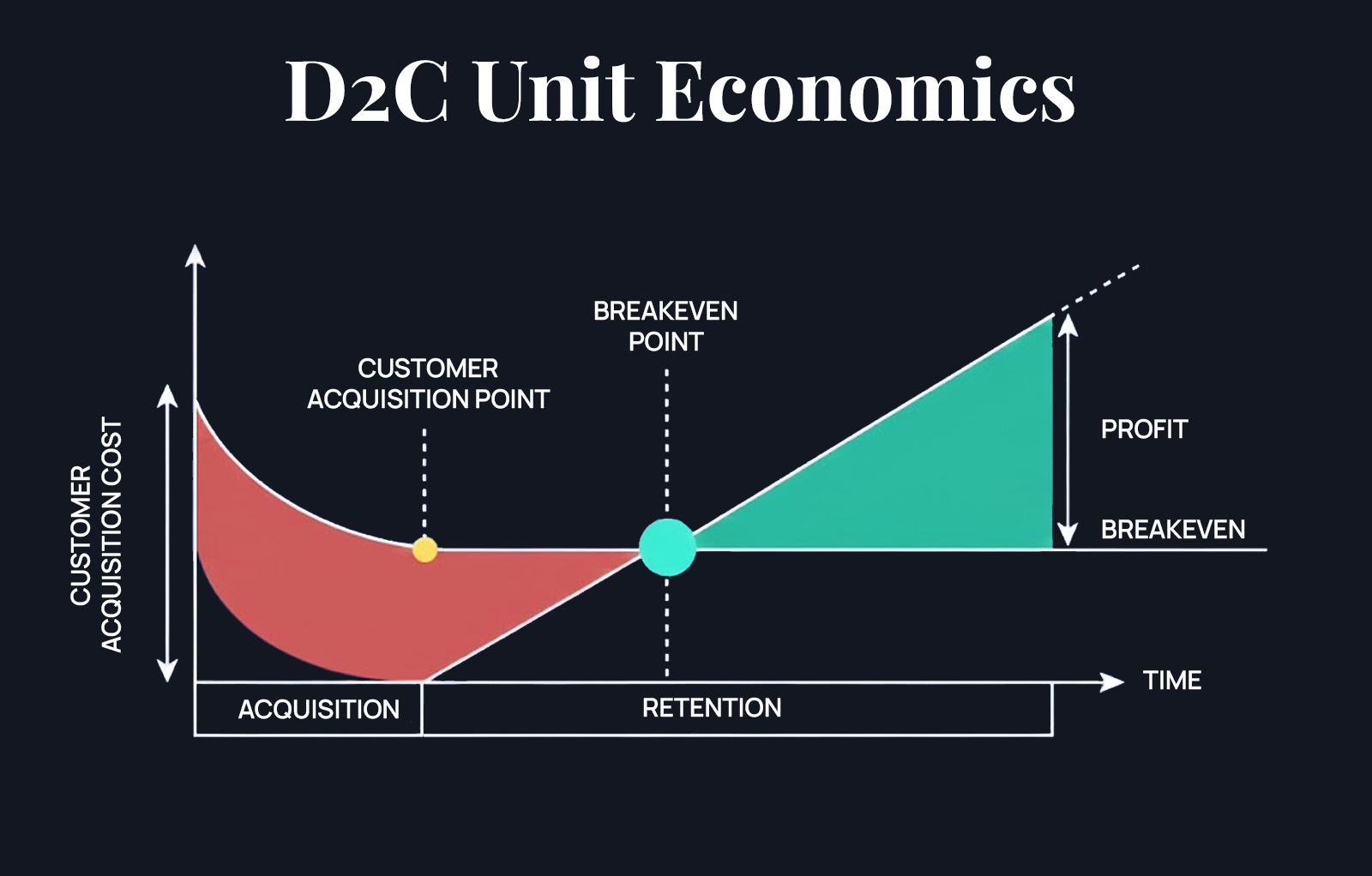
    4. The role of repeat purchase and LTV

    The first order is rarely where the real profit lies.

    D2C becomes powerful when you can acquire a customer once and sell to them multiple times, with lower or zero acquisition cost on subsequent orders.

    Continuing the example:

    • First order:
      • CAC: £25
      • Contribution: £11.90
    • Second order (from email/CRM, no paid CAC):
      • Same product and costs, but CAC now effectively £0
      • Contribution per order becomes: £36.90 (because you’ve removed £25 of paid media cost)

    Now imagine:

    • The average customer buys 1.7 times in the first year.
    • You’re breakeven or modestly profitable on order one, then significantly profitable from order two onwards.

    That’s why understanding LTV is so important:

    If your average LTV is high and your repeat purchase rate is strong, you can afford a higher CAC up front.

    If your product is rarely repurchased (large one-off capital items, for example), you cannot justify the same acquisition cost as a consumable or subscription product.


    5. Fixed vs variable costs: don’t forget the boring bits

    A common mistake is to focus only on variable costs per order, and ignore the fixed costs that come with a D2C channel.

    For example:

    • Ecommerce platform / licence
    • Apps, plugins and integrations
    • Agency retainers or external specialists
    • Partial salary costs for people who will spend time on D2C
    • Photography, creative and content production
    • Warehouse rent, equipment and systems

    These don’t change with each order, but they must be covered by the contribution you make across all orders.

    A simple way to sanity-check this is:

    1. Estimate your monthly fixed costs for D2C (platform, people, agency, overhead contribution).
    2. Divide that by your expected monthly contribution per order.
    3. That tells you how many orders you need per month just to break even on the overhead.

    If that required order volume looks wildly optimistic based on your realistic traffic and conversion assumptions, you have a problem.


    6. Red flags in D2C economics

    As you model the numbers, a few patterns should make you pause:

    • AOV too low, shipping costs too high
      If you’re selling low-ticket items with heavy or awkward shipping, fulfilment can eat your margin.
    • High returns with low resale value
      Fashion brands know this pain. If 30–40% of your orders are coming back, your economics change dramatically.
    • CAC rising faster than AOV or LTV
      Paid media costs tend to creep up. If you don’t improve conversion, AOV or repeat purchase, you quickly get squeezed.
    • Dependence on discounting to convert
      If you can only hit your conversion targets at 20–30% off, you’re training customers to wait for sales and compressing your margin.
    • Overly optimistic repeat purchase assumptions
      “They’ll buy every month” is a nice thought. The data often says otherwise. Assume less and be pleasantly surprised, not the other way round.

    If you spot these early – on a spreadsheet rather than in your P&L – you can adjust your strategy before committing significant budget.


    7. A quick D2C economics checklist

    Before you sign off on a D2C launch, you should be able to answer “yes” to most of the following:

    1. We’ve estimated our AOV, gross margin and key cost components per order.
    2. We understand our likely CAC, based on realistic benchmarks or tests, not guesswork.
    3. We’ve modelled at least three scenarios (conservative, expected, optimistic) for CAC, AOV and repeat purchase.
    4. We know what contribution we need on the first order to make D2C sustainable.
    5. We’ve factored in platform, people, agency and other fixed costs into our breakeven calculation.
    6. We have a clear plan to drive repeat purchase (email, content, subscriptions, loyalty), not just one-off sales.
    7. We know the circumstances under which we’d stop or rework the channel (e.g. CAC above £X for Y months).

    If you can’t yet tick these off, your first job isn’t “launching D2C”. It’s getting the numbers straight.


    8. The upside of doing the maths

    This might all sound a bit sobering. But actually, this kind of clarity is liberating.

    • You’ll launch with realistic expectations rather than hopeful targets.
    • You’ll know what levers to pull when performance is off (AOV, CAC, conversion, repeat).
    • You’ll be able to explain to your board and your team what “good” looks like – and why you’re investing.

    Most importantly, you’ll avoid the trap of thinking:

    “D2C isn’t working”

    when the truth is:

    “We never actually defined what ‘working’ meant in numbers.”

    Understanding the true cost of D2C doesn’t kill the opportunity. It makes it real.

    And once it’s real, you can decide whether D2C is an experiment, a meaningful growth channel, or something you should park for now and revisit later with better economics on your side.

  • From B2B to D2C: How to Launch Without Alienating Your Distributors

    From B2B to D2C: How to Launch Without Alienating Your Distributors

    For many B2B manufacturers and distributors, launching a D2C channel feels a bit like inviting a new child into the family – exciting, full of potential and guaranteed to cause tension if you don’t manage the relationships carefully.

    Your trade partners have helped build your brand. They’ve taken risks on your stock, invested in your category, and educated your customers. The fastest way to destroy that goodwill is to “go D2C” overnight with no explanation and a pricing strategy that makes them look expensive.

    The good news: you can add a D2C channel and keep your distributors on side. But you have to be intentional.

    Here’s how to launch D2C without alienating the people who got you this far.


    1. Decide the job of your D2C channel first

    Most channel conflict comes from confusion about what your D2C site is for.

    If your distributors think you’re trying to replace them, they’ll push back. If they can see that D2C plays a different role in the ecosystem – and can benefit them – the conversation changes.

    Common strategic roles for a D2C channel:

    • Brand flagship
      The best possible presentation of your range, content, story and values. A place where you control photography, copy, education and category structure – which also makes your brand easier to sell for distributors.
    • Test lab
      A controlled environment for testing new SKUs, bundles, pricing, messaging and promotions before rolling them out to partners, armed with data.
    • Long tail & accessories
      A home for niche variants, spares and bundles that distributors don’t want to carry, but customers sometimes need.
    • Service & support hub
      Centralised product information, FAQs, troubleshooting and content that supports both end users and your partners’ sales teams.

    Before you even brief an agency, be able to finish this sentence clearly:

    “Our D2C channel exists to… [X], and complements our distributors by… [Y].”

    That line becomes the anchor for every conversation with trade partners.


    2. Build a fair pricing architecture (and stick to it)

    If your D2C site undercuts your own distributors, you will lose trust. It really is that simple.

    You need a pricing architecture that makes sense commercially and politically:

    • Respect recommended retail pricing
      Hold RRP on your own site as the default. Allow distributors to choose their own price positioning, but don’t make them look foolish for supporting your brand.
    • Compete with value, not raw price
      If you want to make D2C more attractive, use:
      • Bundles that feel premium (e.g. kits, starter sets, refills)
      • Extended guarantees or care packages
      • Content, education and community benefits
        rather than aggressive discounting.
    • Agree promotion guardrails
      Set clear internal rules on:
      • How often you’ll run site-wide discounts
      • Maximum discount depth
      • Key dates (e.g. Black Friday) where you’ll align with partners or give them a head start

    Then communicate this openly with distributors. The goal is that when they see your pricing, it looks predictable and respectful, not erratic and opportunistic.


    3. Use range strategy to reduce conflict, not create it

    You don’t have to sell everything D2C on day one.

    Thoughtful range planning can ease a lot of friction:

    • Core range parity
      Keep your best-selling, high-volume SKUs available through your existing distributors. Don’t hoard the winners for yourself.
    • D2C-only products with a logic
      If you create D2C-exclusive items, make sure there’s a story your partners can accept:
      • Personalised or made-to-order products
      • Niche colours/variants with low volume
      • Direct subscription packs
    • Partner-only products
      Similarly, maintain SKUs that are only available via distributors – for trade, bulk or specialist applications. This sends a strong signal: “You still have something unique.”
    • Bundle differentiation
      Offer different bundle structures D2C vs trade:
      • D2C: curated sets, starter kits, lifestyle bundles
      • Trade: case quantities, mixed boxes, commercial packs

    The aim is not to create artificial complexity, but to show that your D2C channel and your distributors are serving slightly different needs.


    4. Set rules of engagement for marketing and search

    Most visible channel conflict happens on Google and marketplaces, not in boardrooms.

    If your brand, your distributors and large retailers are all bidding on the same terms with no coordination, costs go up and relationships go down.

    Decide in advance:

    • Which keywords you’ll bid on directly
      For example:
      • You focus on brand + generic terms and protect your own name.
      • You give distributors priority on some high-intent category terms.
    • How you’ll handle Shopping ads
      One option is:
      • You run Shopping primarily as a brand-defence and content play.
      • Distributors focus on the long tail and price-driven customers.
    • Marketplace strategy
      If you’re going to list on Amazon, eBay or others:
      • Will you sell directly, endorse a “preferred seller”, or leave it entirely to partners?
      • How will you handle MAP (minimum advertised price) and content standards?

    Documenting these “rules of engagement” and sharing them early shows partners you’re thinking about the whole ecosystem, not just your own site.


    5. Protect and reward your best partners

    The reality is that some distributors are strategically more important than others. Those relationships need reinforcing, not eroding.

    Consider:

    • Early involvement
      Bring key partners into the D2C discussions early. Ask their views. Let them sanity-check your plans. You may not implement everything they suggest, but they’ll feel respected.
    • Exclusive opportunities
      Offer your top partners:
      • Early access to new product launches you’ve validated D2C
      • Co-branded campaigns based on data from your direct customers
      • Joint content (guides, videos, training) that positions their brand strongly too
    • Data sharing
      Your D2C channel will give you rich insights about end users: who they are, what they buy together, how often they repurchase. Sharing appropriate, aggregated insights with partners helps them trade the category better and proves that D2C isn’t just about you.
    • Service guarantees
      Reassure them that:
      • Trade orders still get priority allocation
      • Your D2C warehouse won’t “steal” their stock in peak periods
      • Lead times and support levels remain as agreed

    The unspoken message you want to send is: “We are building this new channel with you in mind, not in spite of you.”


    6. Communicate like adults: before, during and after launch

    Silence breeds paranoia. Rumour travels faster than your official comms.

    Treat your D2C launch as a change-management process:

    Before launch

    • Share your strategic rationale and D2C’s defined “job” in your channel mix.
    • Outline pricing, range and marketing principles.
    • Invite feedback from key accounts and listen carefully for genuine risks you may have missed.

    At launch

    • Communicate the go-live date and what will (and won’t) change for distributors.
    • Provide talking points for their sales teams if end customers mention your new site.
    • Reassure them with real examples of how you’re sticking to your commitments.

    After launch

    • Hold regular reviews with major partners.
    • Share early performance data and what you’re learning.
    • Show how those learnings are feeding into better support, content and innovation for the whole channel.

    Handled well, your D2C launch can actually increase trust because it demonstrates transparency and competence.


    7. A quick checklist: are you ready to move without blowing things up?

    You’re in a strong position to launch D2C without alienating distributors if you can honestly say:

    • We’ve clearly defined the role of D2C in our overall channel strategy.
    • Our pricing plan ensures we don’t systematically undercut our partners.
    • Our range architecture gives both D2C and distributors a meaningful role.
    • We’ve agreed internal rules for paid search, Shopping and marketplaces.
    • We have a plan to share data, content and benefits back into our trade network.
    • Our key partners understand what we’re doing, why, and how it affects them.

    If you’re not there yet, that doesn’t mean you shouldn’t do D2C. It simply means your first job is alignment, not a website build.

    Get the relationships right, and your D2C channel can become a powerful engine for growth, insight and brand strength – not a source of resentment.

    And if “we don’t want to upset our distributors” is the only thing keeping you from exploring D2C, that’s exactly the kind of fear that disappears once you have a proper plan.


    Need help?

  • Are you ready to add a D2C channel?

    Are you ready to add a D2C channel?

    For many B2B manufacturers and distributors, adding a direct-to-consumer (D2C) channel feels like the obvious next step.

    You see your products being sold online by retailers and marketplaces. You’re under pressure to grow. Your board is asking why you’re not “doing more with ecommerce”. So the idea appears: “Let’s just bolt on a D2C channel.”

    The reality? D2C is not a bolt-on.

    A D2C channel changes how you go to market, how you manage your brand, how you work with existing partners, and how your organisation thinks about customers. When it’s done well, it can transform your business. When it’s done badly, it can damage relationships, erode margins and create a lot of internal noise for very little return.

    So the real question isn’t “Should we add D2C?” it’s “Are we genuinely ready to add a D2C channel?”


    Below is a practical way to find out.

    1. Do you know why you want a D2C channel?

    “Everyone else is doing it” is not a strategy.

    Before you even think about platforms and tech, you need absolute clarity on the job your D2C channel will do in your wider go-to-market model. Common strategic reasons include:

    • Owning the customer relationship – building a direct database, understanding who buys your products and how they use them.
    • Testing and learning – launching new products, bundles or propositions at small scale before pushing them out to retailers.
    • Protecting your brand – improving how your products are presented, priced and positioned online.
    • Improving margins – capturing more of the value in the chain (if you can acquire profitably).
    • Serving niche or underserved segments – variants, spares, or long-tail items retailers don’t want to list.

    If you can’t write down a clear, one-sentence answer to:

    “Our D2C channel exists to…”,

    you’re not ready yet. Get the strategy straight first – the rest flows from that.


    2. Have you thought about channel conflict like adults?

    A D2C channel will make some of your existing customers nervous.

    If you sell through distributors, retailers or wholesalers today, they will inevitably ask:

    • “Are you going to undercut us on price?”
    • “Will you keep giving us the same support?”
    • “Are you going to start competing directly with us on Google?”

    If you haven’t already mapped out those concerns and how you’ll respond, you’re walking into a political minefield.

    You need a considered approach to:

    • Pricing architecture – will you hold RRP on your own site? Offer different bundles or configurations? Restrict certain promos to partners?
    • Range strategy – which SKUs will be D2C only, which remain trade-only, and which are sold through both?
    • Marketing rules of engagement – how will you manage paid search, shopping ads and marketplaces so you’re not simply driving up everyone’s CPCs and causing a bidding war?

    If your answer to “How will we explain this to our key accounts?” is essentially “We’ll cross that bridge when we come to it,” then no, you’re not ready yet.


    3. Are your unit economics actually viable?

    D2C doesn’t magically create margin. It simply swaps one cost structure for another.

    Yes, you might remove a wholesale discount. But you add:

    • Customer acquisition costs (Google Ads, Meta, affiliates, etc.)
    • Fulfilment costs (pick, pack, last-mile delivery, packaging)
    • Higher returns, especially if you’re in apparel or consumer products
    • Customer service overheads (pre- and post-purchase support)

    You should be able to answer, in numbers:

    • What’s our target customer acquisition cost (CAC)?
    • What’s our average order value (AOV) likely to be?
    • What gross margin do we make per order after delivery and returns?
    • How many times might a typical customer purchase in 12–24 months?

    If you can’t sketch a simple P&L for a typical D2C order and a typical D2C customer over their lifetime, you’re not ready. You don’t need a perfect model from day one, but you do need to know what “good” looks like so you can spot quickly if it’s not working.


    4. Can your operations deliver a consumer-grade experience?

    Selling to distributors is very different from selling to end customers.

    Consumers expect:

    • Fast, reliable delivery with clear tracking
    • Simple, no-quibble returns
    • Immediate answers to questions (live chat, email, social)
    • Accurate stock information and realistic delivery promises

    Internally, that means stress-testing:

    • Stock & fulfilment – can your warehouse handle single-item, multi-address orders, not just pallets and cartons? Do you need a 3PL?
    • Systems & integrations – can your ERP, ecommerce platform and courier systems talk to each other without manual workarounds?
    • Service & support – who answers product questions, deals with “where is my order?” queries, and handles complaints?

    If your current answer is “We’ll just get the warehouse to pick a few extra boxes” without adapting processes, you’ll quickly frustrate both customers and internal teams.


    5. Do you have (or can you access) D2C skills?

    A D2C channel isn’t simply a website. It’s an ongoing commercial machine.

    You will need, in some form:

    • Ecommerce trading – deciding which products to push, how to merchandise the site, what offers to run, how to react to performance.
    • Performance marketing – managing paid search, social, remarketing and possibly marketplaces.
    • CRM & email – capturing data, sending useful emails, building loyalty and repeat purchase.
    • Analytics & optimisation – understanding funnels, conversion rates, and what to test next.

    You don’t have to hire a massive new team on day one. You can blend internal people, agencies and freelancers. But you do need clear ownership and accountability.

    If “marketing will figure it out” is the plan, you’re likely to end up with an under-resourced channel that never quite reaches its potential.


    6. Is your organisation culturally ready?

    This is the most underestimated piece.

    D2C introduces:

    • New metrics (conversion rate, ROAS, CAC, LTV) that your board may not be familiar with.
    • Faster feedback loops – you’ll see immediately if customers like or hate something.
    • A different decision cadence – weekly and even daily trading decisions, not just quarterly range reviews.

    Ask yourself:

    • Are senior leaders genuinely committed, or is this a “pet project” for someone in marketing?
    • Is there appetite to invest for 12–24 months, or is everyone expecting instant profit?
    • Are you willing to learn in public, make small mistakes and iterate?

    If the business expects a brand-new D2C channel to “wash its face” in three months with tiny budgets and little internal support, it’s better to pause than to launch something half-hearted.


    7. A simple readiness checklist

    If you’re considering D2C, try answering these seven questions honestly:

    1. We can clearly state the primary purpose of our D2C channel.
    2. We have a documented position on pricing, range and how we’ll communicate this to existing partners.
    3. We’ve modelled our basic unit economics and know what success needs to look like.
    4. Our operations and systems can handle single-item orders, returns and consumer-grade service (or we have a credible plan to get there).
    5. We know who is responsible for ecommerce trading, performance marketing, CRM and analytics (even if some are external).
    6. Senior leadership understands that D2C will require investment, learning and time – not just a quick win.
    7. We have a clear initial roadmap: start small, prove the concept, then scale.

    If you can genuinely tick most of these, you’re in a good place to move ahead. If not, the gaps you’ve just uncovered are your action plan.


    So…are you ready?

    Adding a D2C channel can absolutely be the right move. Done well, it gives you closer relationships with your end customers, richer data, stronger brand control and a powerful test bed for innovation.

    But “having a D2C site” and “having a D2C channel that actually grows the business” are two very different things.

    Start with strategy. Be honest about the impact on your partners. Get clear on your numbers. Make sure your operations and people are set up to succeed. Then launch something focused, measurable and deliberately small, and build from there.

    If, as you read this, you’re thinking, “We want to do D2C, but we’re not sure where to start”, that’s a good sign. It means you’re taking it seriously and that, more than anything, is what makes you ready.


    If you’d like some help figuring it out…