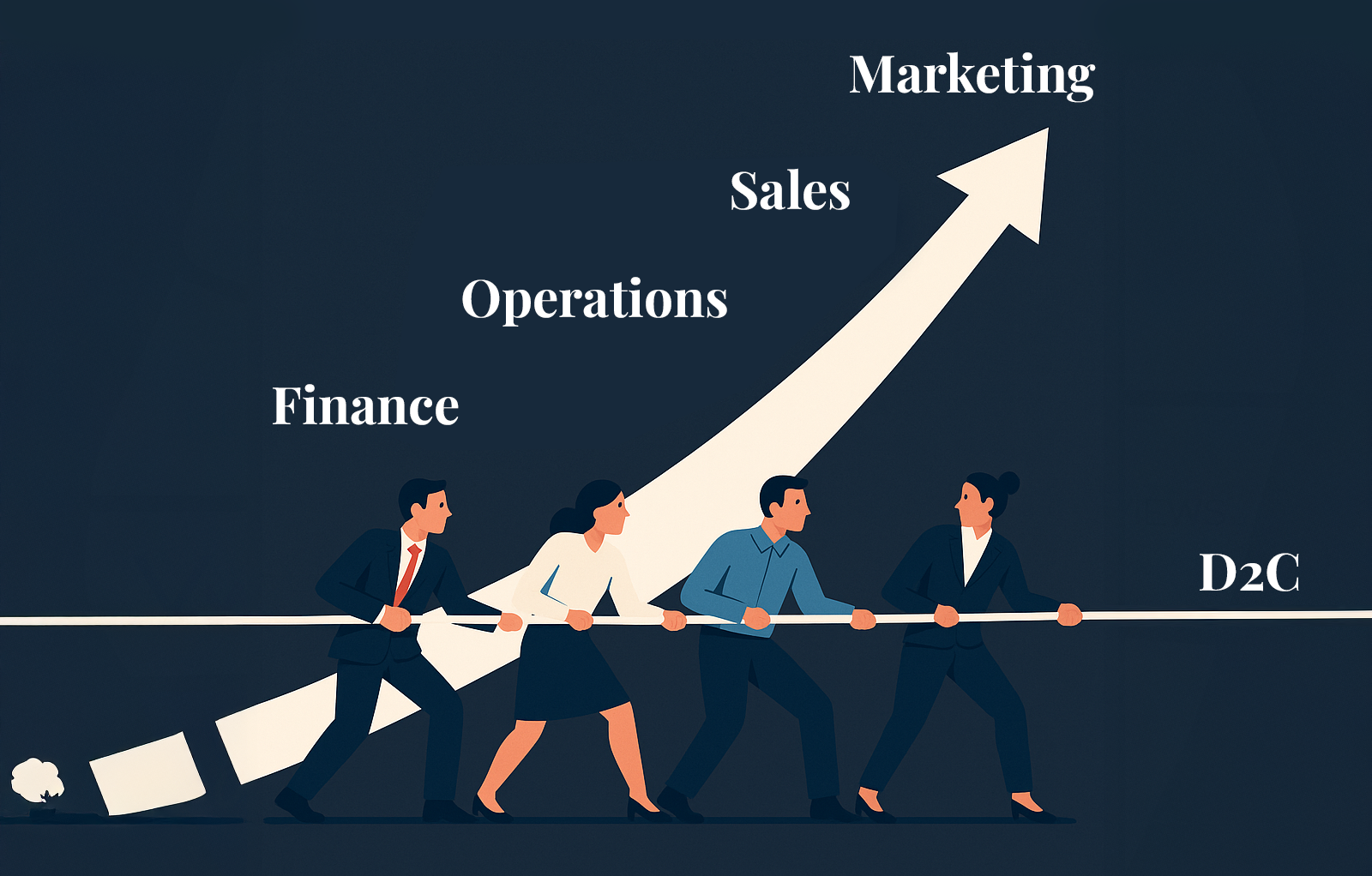
Adding a D2C channel isn’t just a marketing project.
It touches how you sell, how you serve customers, how you plan stock, how you recognise revenue, and how you manage channel relationships. If you treat D2C as “just another website”, you’ll quickly run into internal resistance:
- Sales worry you’re stealing their accounts
- Ops see extra complexity with no extra resource
- Finance sees risk, unclear margins and moving targets
- Marketing feels responsible for everything, but owns very little in reality
The brands that make D2C work don’t just pick the right tech or launch a nice-looking site. They align the organisation around what D2C is for, how it will be measured, and who is accountable for what.
Here’s how to get sales, marketing, operations and finance on the same page before you flip the switch.
1. Start with a clear, shared purpose for D2C
Most internal conflict comes from fuzzy intent.
If sales thinks D2C is there to replace distributors…
If marketing thinks it’s a brand playground…
If finance thinks it’s a margin-fix…
If ops thinks it’s “more work for us”…
…you’re going to spend months firefighting politics.
You need a simple, shared statement of purpose. For example:
“Our D2C channel exists to deepen our relationship with end customers, act as a test lab for innovation, and provide a complementary route to market that supports – not replaces – our trade partners.”
Or:
“Our D2C channel exists to serve niche and long-tail demand, build a direct data asset, and prove concepts before scaling them with retailers and distributors.”
This isn’t just marketing copy. It’s the anchor you use in:
- Board updates
- Sales team briefings
- Ops planning
- Budget discussions
Once everyone agrees why D2C exists, the “how” becomes much easier to negotiate.
2. Bring sales in early (or live with resistance later)
If your field sales or account management team find out about D2C via LinkedIn or a customer email, you’ve already lost.
Their first thoughts will be:
- “Will this hit my numbers?”
- “What am I supposed to say if a customer complains?”
- “Are they quietly replacing me with a website?”
You can avoid a lot of drama by:
Involving them in the design
- Share the D2C purpose and how it fits in the channel mix
- Ask for their input on:
- Which products would cause conflict if sold D2C
- Which customers are most likely to react strongly
- What support they’d need to have confident conversations
Clarifying how commissions and targets work
Nothing undermines trust faster than messing with people’s pay.
Consider:
- Will sales still get recognised when “their” customers buy direct?
- Do you ring-fence certain accounts as “trade only”?
- Do you protect some territories from outbound D2C marketing?
You don’t need a perfect solution immediately, but you do need something that feels fair and is communicated clearly.
Equipping them with a narrative
Give sales simple, honest language they can use:
- Why you’re adding D2C
- What you will and won’t do (pricing, promotions, range)
- How it benefits their customers (better content, support, long-tail products)
- How it benefits them (warmer leads, proven propositions, better assets)
If your sales team understands that D2C is there to support their relationships – not quietly eat them – they’re far more likely to help than hinder.
3. Give marketing ownership without dumping everything on them
Marketing is usually the natural home for D2C – but that doesn’t mean they can or should do everything.
You’ll need clearly defined responsibilities across:
- Trading / merchandising – what you sell, how you present it, what you promote
- Performance marketing – how you acquire traffic and customers
- Brand & content – how the site looks, feels and communicates
- CRM & retention – how you keep customers engaged between purchases
Agree:
- Who owns the commercial performance of the channel (revenue, margin, ROAS)?
- Who has the authority to change prices, run promotions and adjust the range?
- Which decisions require wider sign-off (e.g. discounts that might upset key accounts)?
Marketing can lead, but they need:
- Data from finance
- Operational constraints from ops
- Real-world feedback from sales
D2C performance reviews should be cross-functional by default. If marketing is presenting results “into the void” without sales, ops and finance in the room, you’re missing the point.
4. Get operations in the room before you promise anything
From an ops perspective, D2C is a different sport:
- Smaller, more frequent orders
- Different packaging and labelling standards
- Increased customer service load
- Returns from consumers, not pallets and trade customers
If you design D2C in isolation and then “hand it” to operations, you’ll get understandable pushback:
- “We can’t meet that cut-off time with current staffing.”
- “We don’t have space for that kind of packaging.”
- “Those delivery promises aren’t realistic from this warehouse.”
So:
- Bring ops into the conversation early – at concept stage, not a week before launch
- Ask them:
- What service levels can we confidently deliver today?
- What changes would we need to make for next-day or same-day?
- How will D2C pick/pack fit into existing workflows?
Design your proposition around operational reality, not in spite of it.
And crucially, don’t forget customer service:
- Who answers pre-purchase questions?
- Who handles “where is my order?” queries?
- What hours are you actually available?
If you expect customer service and warehouse teams to take on more work, they need:
- Resource
- Training
- A clear sense of why the business is doing this
5. Let finance set guardrails, not roadblocks
Finance’s job isn’t to say no. It’s to make sure you don’t launch a channel that quietly leaks cash.
Involving finance early helps you:
- Build a realistic D2C P&L
- Agree what “good” looks like in numbers
- Set boundaries for experimentation
Work with them to define:
Core metrics and thresholds
- Acceptable CAC (customer acquisition cost)
- Minimum contribution margin per order
- Target return on ad spend (ROAS) or marketing efficiency ratio
- Payback period on acquisition (e.g. break even on order 1 or within 3 months)
Investment expectations
- Upfront setup (platform, design, integrations)
- Ongoing opex (media, people, fulfilment, tech)
- How long you’re willing to invest before judging success
Reporting rhythm
- Monthly D2C performance pack
- Quarterly deep dives into LTV, cohort behaviour and unit economics
- Clear triggers for scaling up (or pulling back)
When finance understands the logic and levers of D2C, they’re far more likely to back you – and far less likely to panic at the first dip in performance.
6. Agree shared KPIs and a simple governance model
D2C will fail if each function has conflicting success measures.
For example:
- Sales judged purely on trade revenue
- Marketing judged on D2C top-line growth
- Finance focused only on short-term profitability
- Ops focused on volume and efficiency
You get politics, not progress.
Instead, define a small set of shared KPIs, such as:
- D2C revenue and margin
- Contribution after marketing and fulfilment
- New customers acquired and repeat purchase rate
- Customer satisfaction (NPS/CSAT, reviews, returns)
Then:
- Make these visible to all relevant teams
- Discuss them together in a regular D2C trading / steering meeting
- Use them to guide decisions, not just report history
On governance, you don’t need a 40-page document. You do need:
- A cross-functional D2C owner or steering group
- A clear cadence:
- Weekly trading stand-up (tactical changes, quick wins)
- Monthly performance review (deeper analysis, plan adjustments)
- Quarterly strategy review (bigger bets, investment decisions)
And you need to be explicit about:
- What marketing can decide alone
- What requires input from sales / ops / finance
- What goes to the exec team or board
Governance is about speed and alignment – not endless approvals.
7. Communicate internally like you would externally
Many D2C launches fail because the internal communication is worse than the external marketing.
Treat your colleagues like a critical audience:
- Explain the purpose and plan simply
- Share mock-ups and journeys so people can see what’s coming
- Run internal demos of the site before go-live
- Create a short internal FAQ:
- Why are we doing this?
- What does it mean for my team?
- How will we handle pricing, promotions, and key accounts?
- Who do I talk to if I see a problem or have an idea?
Share early wins:
- First orders
- First positive reviews
- First “test and learn” insights that help trade channels
This changes the story from “extra work and risk” to “a project that’s starting to pay off”.
8. A quick organisational readiness checklist
You’re in a good place to align the organisation around D2C if you can say:
- We have a clear, shared statement of D2C’s purpose in our channel mix
- Sales have been informed, consulted and equipped with a fair story and commission logic
- Marketing has clear ownership of D2C performance, but isn’t expected to do everything in a vacuum
- Ops (including customer service) have been involved in defining realistic service levels
- Finance has helped model the economics and set sensible guardrails
- We’ve agreed shared KPIs and a basic governance / decision-making framework
- We have a communication plan for both internal teams and external partners
If a few of these are missing, your first job isn’t “build the site”. It’s to align the people who will make – or break – the channel.
Adding D2C is as much an organisational change project as it is a commercial or technical one.
Get sales, marketing, ops and finance genuinely pulling in the same direction, and your chances of success go up dramatically. Ignore the internal piece, and you’ll spend most of your time managing friction instead of customers.
The technology can always be upgraded.
The relationships, trust and shared understanding across your teams? Those are the real foundations your D2C channel will stand on.
Leave a Reply