Category: Fractional Marketing

  • How Fractional Marketing Leaders Help Manufacturers Go Direct to Consumer

    How Fractional Marketing Leaders Help Manufacturers Go Direct to Consumer

    Here’s how they actually help manufacturers go direct to consumer, step by step.


    1. Start with “why D2C?” – and give it a clear job

    The biggest mistake manufacturers make is treating D2C as a shiny bolt-on:

    “We’ll stick a web shop on the site and see what happens.”

    A good fractional marketing leader starts with a different question:

    • What job is D2C going to do for this business?

    For example, D2C might be there to:

    • Improve margins on selected products
    • Test new products, bundles or pricing before pushing them to retail
    • Build a direct relationship with end users (data, feedback, reviews)
    • Serve niches your distributors ignore because they’re “too small”
    • Support your brand story with educational content and support

    They’ll help you define a tight, realistic role for D2C so it supports your existing channels rather than randomly competing with them.


    2. Design D2C so it doesn’t blow up your trade relationships

    Channel conflict is the thing that keeps most manufacturers from moving.

    A fractional marketing leader will work through questions like:

    • Which products should be sold D2C, and which should stay trade-only?
    • How do we structure pricing so we’re not publicly undercutting distributors?
    • Can we differentiate by range, service or experience rather than price?
    • How do we communicate this clearly to our partners?

    That often leads to decisions such as:

    • Limiting D2C to certain SKUs, bundles or spare parts
    • Keeping some “trade only” lines or pack sizes
    • Adding value D2C (content, support, customisation) rather than simply discounting
    • Agreeing simple channel rules internally so sales don’t panic every time a D2C order arrives

    The aim isn’t to “sneak D2C in”. It’s to create a channel strategy where your distributors still have a clear role, and D2C fills the gaps they were never going to fill well anyway.


    3. Translate product thinking into consumer language

    Most manufacturers talk in specs, part numbers and tolerances.

    End consumers do not.

    A fractional marketing leader helps you:

    • Define who you’re selling to directly (DIYers? hobbyists? small workshops? pros buying for themselves?)
    • Translate your technical strengths into benefits people actually care about
    • Position your brand as something more than “another supplier of X”

    That might involve:

    • Rewriting product descriptions so they’re understandable and persuasive
    • Creating comparison pages that help people choose the right product
    • Building guides, how-tos and usage content that reduce returns and increase confidence
    • Using your heritage, quality and technical expertise as part of the brand story

    They bridge the gap between engineering reality and consumer decision-making.


    4. Choose the right D2C tech stack (without overcomplicating it)

    You don’t need a monster ecommerce build to test D2C.

    A fractional marketing leader will usually:

    • Recommend a sensible platform (often Shopify for most manufacturers starting out)
    • Keep the stack lean: ecommerce, email, reviews, analytics, maybe a basic CRM
    • Avoid over-engineering “because one day we might need…”

    They’ll focus on:

    • Making it easy for customers to buy the handful of products that matter most
    • Ensuring tracking is set up properly from day one
    • Integrating with your existing systems just enough to avoid operational chaos, without trying to rebuild your whole ERP around D2C in phase one

    The goal is a simple, robust D2C engine – not a two-year IT project.


    5. Decide what to sell first (and what to leave alone)

    Not every product belongs in a D2C catalogue.

    A fractional marketing leader will help you:

    • Identify hero products suitable for D2C – high demand, good margin, easy to ship
    • Create bundles and kits that solve real problems (and differentiate from your trade offer)
    • Decide which lines are a terrible idea to send through courier networks (oversized, fragile, low-margin bulk, etc.)

    They’ll push you to launch with a focused range instead of dumping your entire catalogue online.

    This concentration makes marketing easier, conversion higher, and operational headaches smaller.


    6. Build a realistic go-to-market plan (not just “run some ads”)

    Going D2C is not just “turn on Google Ads”.

    Your fractional marketing leader will:

    • Choose 1–2 primary channels to start with (e.g. Google Shopping + Meta ads, or search + email)
    • Define a test budget and a clear way of measuring success
    • Create a simple launch plan: pre-launch interest, launch offer, follow-up
    • Design an initial retention journey – email flows for new customers, cross-sell, and repeat purchase

    Crucially, they’ll link every activity to:

    • A target CPA / ROAS
    • A target contribution margin
    • A feedback loop into product and ops (e.g. which SKUs are flying, which are causing support issues)

    They’re not there to fiddle with ad buttons all day – they’re there to own the commercial logic behind your marketing.


    7. Protect operations and customer experience

    D2C exposes you to things your distributors used to absorb:

    • Last-mile delivery issues
    • Fussy customers
    • Returns and refunds
    • Packaging complaints
    • “Where’s my order?” emails

    A fractional marketing leader will:

    • Work with ops and customer service to set realistic promises on delivery and returns
    • Help define packaging and unboxing standards that protect the product and the brand
    • Build clear FAQs, help content and post-purchase comms to reduce pressure on the phone lines
    • Use customer feedback and reviews to improve products and processes

    They’ll make sure your first impression in the consumer world is positive and sustainable, not a flood of one-star reviews because you copied your wholesale processes directly over to B2C.


    8. Align sales, finance and the board

    D2C fails inside manufacturers more often because of internal politics than external performance.

    A fractional marketing leader helps:

    • Sales understand that D2C is not there to “steal their orders”
    • Finance see a clear plan for payback, not an open-ended cost centre
    • The board see how D2C supports valuation, resilience and brand strength

    They’ll put in place:

    • Simple, agreed reporting on D2C performance
    • Guardrails on pricing and discounting
    • Clear agreements on how to handle overlaps with key accounts

    In other words, they make D2C feel like a planned part of the commercial strategy, not a rogue side project.


    9. Build capability, not dependency

    Finally, a strong fractional marketing leader isn’t trying to become permanent.

    While they’re with you, they will:

    • Put structure and rhythm around D2C marketing (plans, reviews, reporting)
    • Up-skill your internal team or help you hire your first ecommerce/marketing roles
    • Create playbooks and processes (campaign templates, email flows, launch checklists)

    The idea is that, over time:

    • Your team can run the D2C channel confidently
    • You know which levers to pull to grow it further
    • You can choose whether to keep them on in a lighter-touch role or bring more in-house

    You’re not just buying “some help with ads”. You’re building a new muscle in the business.


    In summary

    Manufacturers don’t go D2C just by putting a “Buy Now” button on the website.

    They succeed when someone:

    • Defines a clear role for D2C in the overall channel mix
    • Protects trade relationships while opening up new opportunities
    • Translates technical products into consumer-friendly offers
    • Chooses a sensible tech stack and a focused product range
    • Builds a testable, numbers-driven go-to-market plan
    • Keeps operations, sales, finance and the board aligned
    • Leaves behind a stronger team and function than they found

    That’s what a good fractional marketing leader does for manufacturers going direct to consumer: they turn D2C from a risk and a rumour into a controlled, profitable, strategically useful channel.

  • How to Measure the ROI of a Fractional Marketing Leader

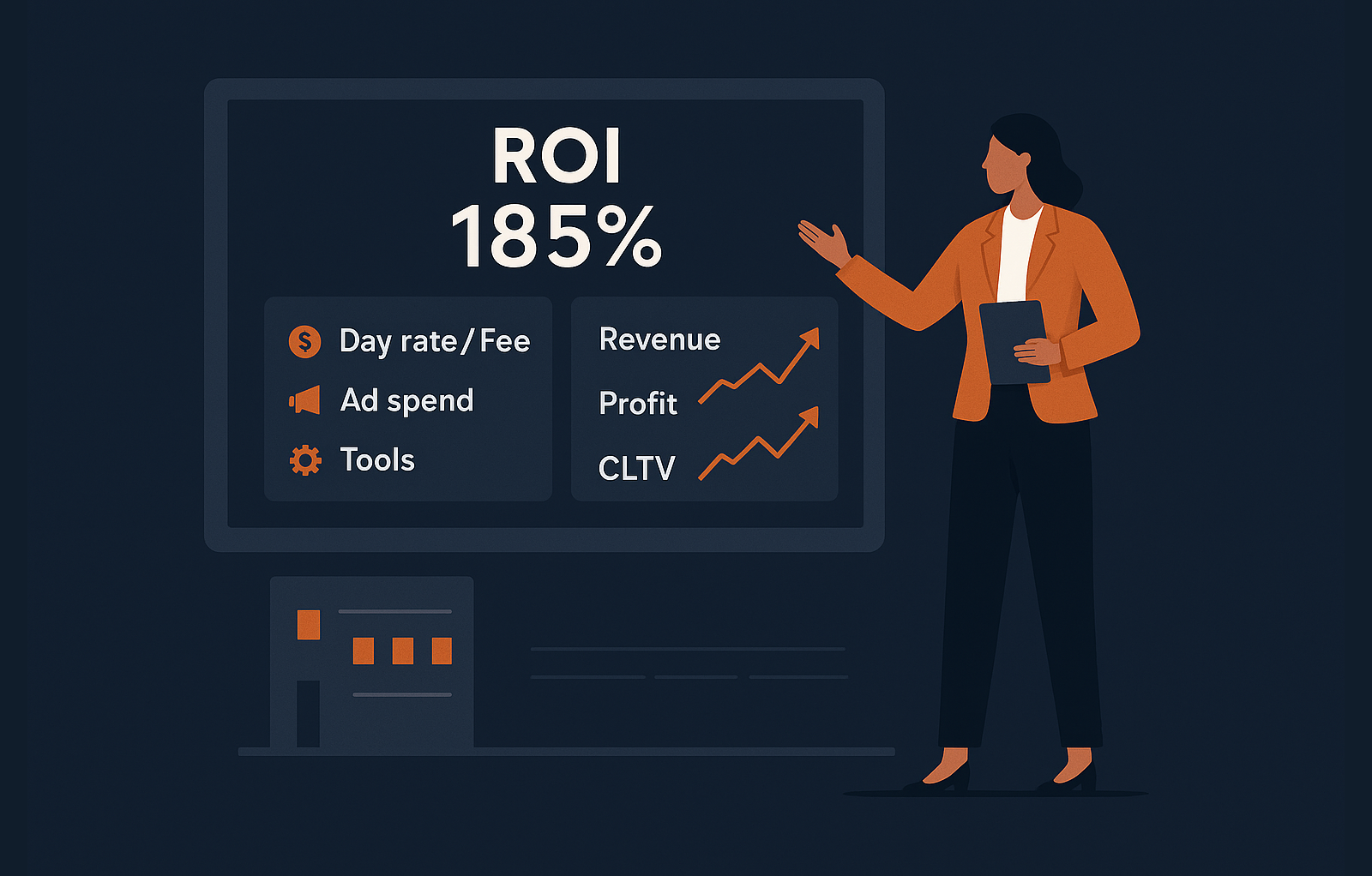
    How to Measure the ROI of a Fractional Marketing Leader

    Bringing in a fractional marketing leader can feel like the right move – senior expertise, strategic clarity, better use of budget. But sooner or later, someone (often your FD or an investor) will ask:

    “What exactly are we getting for this fee?”

    If you can’t answer that clearly, the engagement will always feel fragile, no matter how good the work is.

    The good news: you can measure the ROI of a fractional marketing leader – you just need to be deliberate about it from day one.

    Here’s how to do it.


    1. Get clear on the cost (properly)

    Before you can measure return, you need to know what you’re actually investing.

    That’s not just their day rate. Think of:

    • Fractional leader fees – retainer, day rate, or project fee
    • Knock-on investments they recommend – e.g. ad budget increase, new tools, extra resource
    • But also savings they create – e.g. cutting wasted spend, consolidating tools, reducing agency costs

    For the purpose of their ROI, start with:

    Total cost of fractional leader over X months
    (e.g. £4,000/month × 6 months = £24,000)

    We’ll come back to this when we talk about uplift.


    2. Establish a baseline before they start

    This is the step most businesses skip – and then wonder why ROI feels fuzzy later.

    Before your fractional leader gets going, snapshot where you are today. For example:

    Top-line numbers:

    • Monthly revenue (by channel, if possible)
    • Gross margin %
    • Marketing spend (total and by channel)
    • Contribution margin (revenue – direct costs – marketing spend)

    Key marketing performance metrics:

    • Website conversion rate
    • Average order value (AOV) or average deal size
    • Cost per lead / cost per acquisition
    • ROAS / MER (marketing efficiency ratio)
    • Repeat purchase rate or lead-to-opportunity / opportunity-to-sale rates

    Operational / qualitative reality:

    • How decisions are made (“gut feel”, “agency tells us”, “no idea”)
    • How the team feel (overwhelmed, unclear, underused)
    • How confident you are in your numbers (1–10)

    It doesn’t need to be perfect – but capture enough that you can say, six months later: “Here’s where we started.”


    3. Agree what success looks like (and over what time frame)

    ROI is impossible to measure if you never agreed on what “good” looks like.

    With your fractional leader, define:

    • Primary goal(s) – no more than three
      • e.g. “Increase online revenue by 25% while maintaining margin”
      • e.g. “Reduce blended CPA by 20%”
      • e.g. “Double the volume of sales-qualified leads at the same spend”
    • Time frame
      • 90 days for foundations and quick wins
      • 6–12 months for fuller ROI
    • Constraints
      • “We can’t increase paid media budget for 3 months”
      • “We have limited dev resource”
      • “We must protect distributor relationships”

    Write this down. This is the lens you’ll use to judge ROI later.


    4. Measure financial ROI in a simple way

    Now to the bit everyone cares about: money.

    Step 1: Look at incremental profit, not just revenue

    Revenue is nice. Profit is better.

    You want to know:

    “By how much did profit improve relative to their cost?”

    Rough-and-ready way to think about it over the period:

    1. Calculate contribution before they started
      • Contribution = Revenue – Cost of Goods – Marketing Spend
    2. Calculate contribution after they’ve had time to make an impact
      • Same formula, but now with new revenue and spend levels
    3. Work out the uplift
      • Contribution uplift = Contribution (after) – Contribution (before)
    4. Compare that uplift to their cost

    For example, over 6 months:

    • Before: average monthly contribution = £80,000
    • After: average monthly contribution = £95,000
    • Uplift = £15,000/month → £90,000 over 6 months

    Fractional leader cost over 6 months = £24,000

    Very simple ROI:

    ROI = (Uplift – Cost) ÷ Cost
    = (£90,000 – £24,000) ÷ £24,000
    = 2.75 → 275% ROI

    Is it perfect? No. Is it good enough for board-level conversations? Yes.


    Step 2: Include cost savings as part of ROI

    A good fractional leader doesn’t just drive more revenue – they often stop you wasting money:

    • Killing unprofitable campaigns
    • Consolidating tools and subscriptions
    • Negotiating smarter with agencies
    • Stopping “pet projects” that never deliver

    If they’ve saved, say, £2,000/month in wasted spend without harming performance, that’s £12,000 over 6 months – add that to the “uplift” side of the equation.

    Suddenly, they’re not just a cost – they’re actively paying for themselves.


    5. Track leading indicators (the early wins)

    Financial ROI often lags. You may not see the full impact on revenue and profit for several months, especially in longer sales cycles.

    That’s where leading indicators come in. These are earlier signals that things are moving in the right direction.

    Examples:

    • Website conversion rate up from 1.2% → 1.8%
    • AOV up from £95 → £110
    • Email now contributing 15% of revenue, up from 6%
    • Blended CPA down from £50 → £38
    • ROAS improved on key campaigns
    • Lead-to-opportunity conversion rising
    • Sales cycles shortening

    These are all things a fractional leader should be influencing before the full revenue impact lands.

    Agree which leading indicators you’ll track together, and review them monthly.


    6. Don’t ignore non-financial ROI (but make it visible)

    Some of the biggest benefits are harder to quantify but still very real:

    • Founder time freed up from trying to “do marketing” themselves
    • Better decisions – fewer knee-jerk changes to strategy
    • Calmer team – less chaos, clearer priorities
    • Stronger marketers – team members levelling up under proper leadership
    • Cleaner data – you can actually trust your numbers now
    • Better agency relationships – clearer briefs, more accountability

    You can still measure some of this:

    • Ask your team and key stakeholders to rate, monthly or quarterly (1–10):
      • Clarity of marketing priorities
      • Confidence in the plan
      • Quality of cross-team communication
      • Stress levels around marketing and launches
    • Log founder time – roughly how many hours per week you spent on marketing decisions before vs after

    These won’t go into a strict ROI formula, but they absolutely matter when deciding whether to continue the engagement.


    7. Use a simple monthly scorecard

    To keep it practical, you can roll all of this into a one-page scorecard reviewed every month.

    For example, rate each area 1–5:

    1. Growth & revenue impact
      • Are key financial metrics moving in the right direction?
    2. Efficiency & spend quality
      • Are we getting more from the same budget, or the same from less?
    3. Clarity & decision-making
      • Do we know our priorities? Are decisions faster and better?
    4. Team capability & confidence
      • Are our marketers and sales team more capable and aligned?
    5. Founders’ peace of mind
      • Do we feel in control of marketing, or still in the dark?

    Over 3–6 months, you should see those scores trend upwards alongside your financial metrics. If not, that’s a red flag.


    8. Be realistic about attribution

    One important nuance: a fractional marketing leader doesn’t work in a vacuum.

    Sales, product, operations, the economy – all of these affect performance.

    You’re not trying to prove that “every extra pound came solely from them”. Instead, ask:

    • Are we performing meaningfully better than our baseline in the areas they influence?
    • Would we realistically have made the same progress without their involvement?

    If:

    • Revenue and contribution are up
    • CPAs are down or stable
    • Marketing feels more controlled and less chaotic
    • The team is clearly stronger
    • And this all happened after bringing them in

    …you can be confident you’re getting positive ROI, even if you can’t attribute every penny perfectly.


    9. When to question the ROI

    It’s equally important to know when things aren’t working.

    Start asking hard questions if:

    • There was no clear baseline and still no clear metrics
    • You’re getting a lot of activity but no noticeable shift in outcomes
    • Reporting is full of vanity metrics (impressions, likes) but light on revenue, margin and CPA
    • The team still seem as lost or overwhelmed as before
    • You’ve been working together for 6+ months and:
      • Revenue is flat or down with no clear explanation
      • Efficiency hasn’t improved
      • There’s no strong case for “we’d be worse off without this”

    At that point, either the scope is wrong, or the relationship is.


    Bringing it all together

    Measuring the ROI of a fractional marketing leader isn’t about building a perfect financial model. It’s about answering, with a straight face:

    • Are we making more money, more efficiently, than before?
    • Is our marketing function stronger and more controlled?
    • Has this person’s involvement clearly moved us forward?

    If you establish a baseline, agree clear goals, track both financial and non-financial impact, and review everything with a simple scorecard, you’ll know the answer.

    And if the answer is “yes”, their fee stops feeling like a cost – and starts looking like one of the smartest investments you’ve made.

  • What Does a Fractional Marketing Leader Actually Do?

    What Does a Fractional Marketing Leader Actually Do?

    “Fractional marketing leader” sounds fancy. In reality, it just means this:

    You get a senior Head of Marketing / CMO for a slice of the week, instead of paying for them full-time – but they’re still responsible for making marketing actually work.

    If you’re a founder or MD, that can feel a bit vague. Are they a strategist? A consultant? A manager? A glorified freelancer?

    Here’s what a good fractional marketing leader actually does in the real world.


    1. Owns the marketing outcome, not just the activity

    Most businesses already have marketing activity:

    • Google Ads running
    • An agency doing “SEO”
    • Someone posting on LinkedIn or Instagram
    • A website that was “redone” two years ago
    • An email platform you’re not really using

    A fractional marketing leader’s first job is to own the outcome, not the list of tasks.

    That usually means:

    • Agreeing clear, commercial goals (e.g. “grow online revenue by 30% without killing margin”)
    • Mapping how marketing can actually influence those goals
    • Holding the threads: channels, agencies, people, budget and reporting

    They become the person who answers the question:
    “Is our marketing working, and what are we doing about it?”


    2. Diagnose what’s really going on

    Before they recommend anything, a good fractional leader gets under the bonnet.

    That typically includes:

    • Reviewing analytics (site traffic, conversion rate, AOV, repeat purchase, lead quality)
    • Looking at channel performance (PPC, SEO, email, social, marketplaces, etc.)
    • Understanding your margin structure and which products/services really matter
    • Listening to sales calls or talking to the sales team
    • Reviewing your customer journey from first click to repeat purchase
    • Asking annoying-but-essential questions about stock, lead times, pricing and ops

    The goal isn’t a pretty audit document. It’s to answer:

    • Where are we leaking money?
    • Where are we leaving money on the table?
    • Which levers will move the needle fastest in the next 90 days?
    • What needs fixing for the long term?

    Only then do they talk about plans.


    3. Set a clear strategy and 90-day plan

    Once they understand the reality, they create two things:

    1. A simple strategy – who you’re targeting, what you’re selling, why people should care, and which channels matter most.
    2. A ruthless 90-day plan – what will actually be done, by whom, and in what order.

    That might look like:

    • Focusing on one or two priority customer segments
    • Choosing a handful of hero products or services to push
    • Deciding which channels to double down on – and which to pause
    • Defining your core message and offers
    • Lining up quick wins (e.g. low-hanging CRO fixes, obvious PPC waste, simple email flows)

    The key thing: it’s not theoretical.

    It’s:

    • Specific (“We will pause X, move £Y to Z, fix these three pages, and build these two campaigns.”)
    • Sequenced (“Weeks 1–4: fix foundations. Weeks 5–8: scale what’s working.”)
    • Tied to numbers (revenue, margin, CPAs, conversion rates, lead-to-opportunity, etc.)

    4. Lead your marketers, not replace them

    A fractional marketing leader is not there to “do all the marketing”. They are there to lead it.

    In practice, that means:

    • Giving your existing marketers clarity on priorities
    • Helping them decide what not to do
    • Setting expectations around quality and speed
    • Running regular check-ins and performance reviews
    • Coaching them so they grow, rather than just executing orders

    If you don’t have a team yet, they can also:

    • Help you decide what roles you actually need (in-house vs agency vs freelancers)
    • Write job specs
    • Sit in on interviews
    • Onboard new hires so they’re productive quickly

    You’re buying not just skills, but leadership and judgement.


    5. Direct and challenge your agencies

    Many businesses are over-reliant on agencies who are:

    • Doing some good work
    • But not always aligned to your commercial priorities
    • And often not properly challenged or briefed

    A fractional marketing leader acts as your side of the table.

    They will:

    • Write tighter, more commercial briefs
    • Check whether the agency’s proposed work links back to your goals
    • Challenge spend that isn’t justified
    • Ask awkward questions about performance and reporting
    • Make sure agencies aren’t marking their own homework

    This doesn’t have to be confrontational. Good agencies are usually relieved to have a grown-up marketing contact who understands their world and can make decisions.


    6. Own performance and reporting (in plain English)

    Founders don’t want a 40-page slide deck every month. They want to know:

    • Are we up or down?
    • Why?
    • Is it a blip or a trend?
    • What are we doing about it?

    A fractional leader designs a simple, repeatable performance rhythm, for example:

    • A monthly marketing review with the founder/MD
    • A lean report with:
      • Key numbers (revenue, margin, leads, ROAS, conversion rate, AOV, repeat purchase, etc.)
      • Commentary on what moved and why
      • Decisions made and actions for next month

    They translate data into decisions. No hiding. No fluff.

    Over time, this rhythm makes marketing feel calmer and more controlled, even if the numbers aren’t perfect yet.


    7. Fix processes and foundations

    Often, the block to growth isn’t “no ideas”. It’s foundations:

    • No proper tracking or attribution
    • Slow sign-off processes
    • A CMS that makes changes painful
    • No templates for campaigns or landing pages
    • No standard way of launching new products or offers

    A fractional marketing leader will quietly:

    • Introduce better ways of working (campaign checklists, templates, naming conventions)
    • Tighten the relationship between marketing, sales, and ops
    • Clean up tracking so your data is trustworthy
    • Simplify workflows so things actually get done

    This is the unglamorous work that makes every future campaign more effective.


    8. Help you make better commercial decisions

    The best fractional leaders are commercially minded.

    They don’t just ask, “Will this campaign get clicks?”
    They ask, “Does this make sense for our margins, capacity and risk?”

    They’ll be involved in questions like:

    • Should we discount or add value instead?
    • Which products should be front and centre on the website?
    • Should we focus on acquisition or driving repeat purchases?
    • Is this new channel worth testing now, or a distraction?
    • How do we add D2C without upsetting distributors or retailers?

    They become a sounding board for growth decisions – someone who understands both marketing and the operational reality of your business.


    9. Build something that outlives them

    A fractional marketing leader who does their job well is not trying to stay forever.

    Their aim is to:

    • Build a clearer strategy
    • Put better foundations in place
    • Lift the capability of your people
    • Leave you with a marketing function that can run without constant drama

    That might end in:

    • Hiring a full-time Head of Marketing
    • Reducing their days as the team grows
    • Or staying on in a lighter-touch advisory capacity

    Either way, you should feel that:

    • Marketing is more controlled and predictable than before
    • You understand what’s working and what isn’t
    • Your team are stronger and more confident
    • The engine will keep running, even if they step back

    10. So what are you actually buying?

    You’re not just buying a few days a month.

    You’re buying:

    • Ownership of marketing outcomes
    • Clarity on where growth will really come from
    • Focus on the right channels and products
    • Leadership for your team and agencies
    • Honest reporting you can actually act on
    • Calmer, more predictable marketing that supports your wider goals

    That’s what a fractional marketing leader actually does.

    If your current reality is “lots of activity, not much direction”, then bringing in someone to own this – even for just a few days a month – can be the difference between random acts of marketing and a proper growth engine.

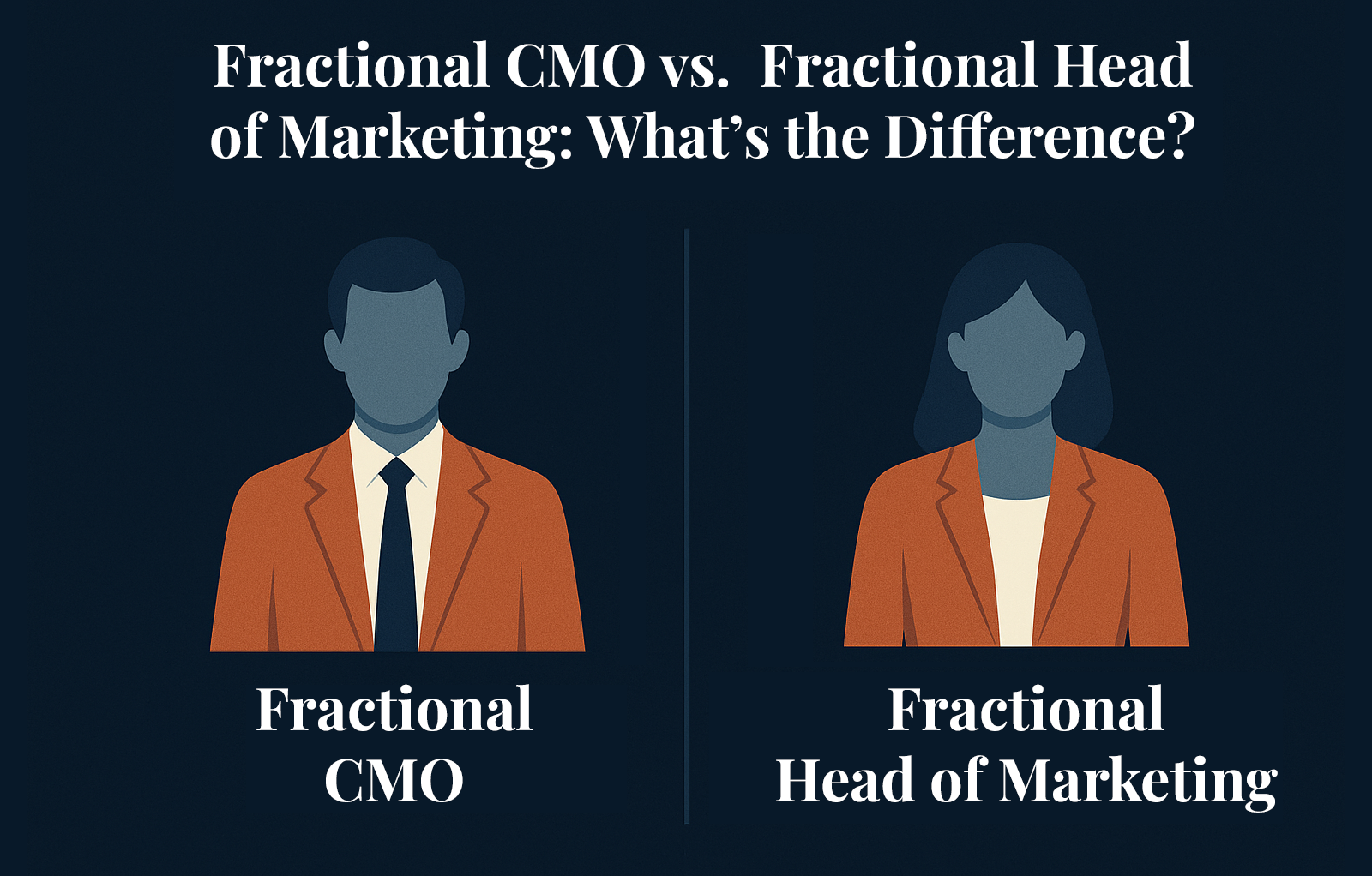
  • Fractional CMO vs Fractional Head of Marketing: What’s the Difference?

    Fractional CMO vs Fractional Head of Marketing: What’s the Difference?

    If you’re a founder or MD trying to level up your marketing, you’ve probably seen both titles thrown around: fractional CMO and fractional Head of Marketing. They sound similar; they’re both senior, they’re both part-time and they both talk about strategy and growth.

    So what’s the actual difference – and which one do you need?

    At the simplest level:

    • A fractional CMO is there to shape board-level marketing and growth strategy.
    • A fractional Head of Marketing is there to run the marketing function day-to-day and turn strategy into execution.

    You can think of it as “where they sit in the business” and “how close to the work they get”.

    Let’s break it down.


    What is a Fractional CMO?

    A fractional CMO (Chief Marketing Officer) behaves like a part-time member of your executive team.

    They’re focused on questions like:

    • What markets should we be in over the next 3–5 years?
    • How do we position the brand against current and future competitors?
    • How does marketing support the overall growth and exit plan?
    • Where should we invest (and not invest) to maximise long-term value?

    Typical responsibilities:

    • Sitting in leadership or board meetings
    • Owning the overall go-to-market and brand strategy
    • Aligning marketing with sales, product, finance and operations
    • Setting high-level budgets and investment priorities
    • Defining the KPIs that really matter to the business
    • Making decisions about major shifts: new markets, acquisitions, big rebrands, pricing strategy, etc.

    They’re often less involved in the fine-grain “how” of the work – the campaign calendars, landing pages, email flows – and more focused on direction, priorities and trade-offs.

    A fractional CMO is usually best for businesses that:

    • Are £10m+ revenue or aiming for a significant fundraise or exit
    • Have an existing marketing team and/or agencies in place
    • Need a senior voice who can talk marketing and commercial strategy with investors, the board or PE

    What is a Fractional Head of Marketing?

    A fractional Head of Marketing is closer to the engine room.

    They still think strategically, but their main focus is:

    “How do we translate the strategy into a concrete plan and actually get it done?”

    Typical responsibilities:

    • Turning business goals into a marketing roadmap and campaigns
    • Managing and coaching in-house marketers
    • Briefing and directing agencies or freelancers
    • Making channel-level decisions (PPC, SEO, email, social, marketplaces, etc.)
    • Owning day-to-day performance: leads, revenue, ROAS, conversion rate, AOV, repeat purchase
    • Creating or improving processes, reporting and ways of working

    They’re more hands-on – reviewing ad accounts, challenging targeting, improving landing pages, refining email flows, prioritising what the team works on next.

    A fractional Head of Marketing is usually best for businesses that:

    • Are in the £1m–£20m revenue range
    • Have some marketing activity, but it’s a bit messy, reactive or disjointed
    • Need someone to own the function, not just advise from the sidelines
    • Don’t yet have the budget (or need) for a full-time senior hire

    Board-Level Strategy vs Hands-On Leadership

    The key difference isn’t just seniority – it’s where they create value.

    A fractional CMO is about board-level strategy:

    • Long-term positioning and market strategy
    • Brand architecture (how your products and sub-brands fit together)
    • Decisions around pricing, packaging and propositions
    • Ensuring marketing has a voice in big commercial decisions
    • Reporting to investors or the board on marketing’s contribution to growth

    They’ll ask questions like:

    • “Should we enter Germany now or wait 18 months?”
    • “What categories do we need to own if we want to be the leader in this space?”
    • “How do we need to reposition to justify higher prices or bigger deals?”

    They may influence the day-to-day, but they’re not typically the person building the campaign calendar or checking whether your UTM tags are set up properly.

    A fractional Head of Marketing is about hands-on leadership:

    • Taking the overall strategy and turning it into a concrete plan
    • Making sure the right things get done, in the right order
    • Bringing structure, focus and pace to your marketing efforts
    • Coaching junior/mid-level marketers to perform at a higher level
    • Owning performance reviews and making adjustments every week/month

    They’ll ask questions like:

    • “What are the 3 biggest levers we can pull in the next 90 days?”
    • “Which products should we focus on first for D2C?”
    • “Why is this campaign not converting – is it the offer, the targeting or the landing page?”

    They bridge the gap between strategy and execution.


    Which Do You Need Right Now?

    Here’s a simple way to think about it.

    You probably need a fractional Head of Marketing if:

    • You’re turning over somewhere between £1m and £20m
    • You’ve grown mostly through founder hustle, sales and referrals
    • You’ve got some channels running (PPC, SEO, email, socials), but:
      • You’re not sure what’s actually working
      • Everything feels tactical and reactive
      • Your team are busy but not always focused on the right things
    • You don’t have a single person who owns marketing end-to-end

    In this case, the biggest win is to sort the engine out: get clarity, a realistic plan, proper measurement, and a calm, competent leader to run it.

    A fractional Head of Marketing will:

    • Create a clear plan for the next 90 days and 12 months
    • Bring alignment between founders, sales and marketing
    • Improve performance from existing spend before asking for more budget
    • Build the foundations for a proper function (processes, reporting, roles)

    Once that’s in place, you might later bring in a fractional CMO to help with larger strategic questions – expansion, M&A, serious brand repositioning, etc.


    You probably need a fractional CMO if:

    • You’re £10m+ and growing, or planning for a fundraise or exit
    • You already have a marketing team and/or agencies delivering day-to-day
    • Investors or the board are asking complex questions about growth strategy
    • You’re exploring big moves: new markets, acquisitions, major rebrands, radical pricing changes
    • You need someone who can challenge and shape the company’s direction, not just marketing activity

    In this case, the biggest win is alignment at the top: sharpening the growth story, ensuring marketing is pulling in the same direction as sales, product and finance, and making smarter big bets.

    A fractional CMO will:

    • Define the overall growth strategy and positioning
    • Decide what markets, segments and propositions to prioritise
    • Work closely with the board or investors on the growth story and metrics
    • Set expectations and guardrails for the Head of Marketing and the team

    Can One Person Do Both?

    Sometimes, especially in smaller businesses, one fractional leader will blend both roles:

    • Board-level conversations about direction and growth
    • Hands-on leadership of the team and channels

    That can work well if:

    • You’re under ~£20m revenue
    • The leadership team is still relatively small
    • You want to avoid having two separate senior marketing roles

    In that case, the title almost matters less than the scope you agree together:

    • How much time is spent on strategy vs day-to-day leadership?
    • Who do they report to, and which meetings do they attend?
    • What are the primary outcomes they’re accountable for in the next 6–12 months?

    Be explicit. If you hire a “fractional CMO” but secretly expect them to be a very hands-on Head of Marketing, you’ll both end up frustrated.


    How to Decide (In Plain English)

    Ask yourself:

    1. What’s my biggest marketing problem right now?
      • “I don’t know what we should do next” → more CMO
      • “I know roughly what we should do, but no one’s owning it or executing it well” → more Head of Marketing
    2. Where is the pain – the boardroom or the engine room?
      • Boardroom: questions about overall direction, markets, brand story, investor conversations
      • Engine room: messy channels, lack of focus, inconsistent execution, no owner
    3. What do I actually want to be different in 12 months?
      • Sharper growth story, stronger position with investors, bigger strategic moves → fractional CMO
      • Better results from current spend, clearer plan, stronger team and processes → fractional Head of Marketing

    Get those answers clear, and the choice usually becomes obvious.


    Final Thought

    Both roles can be transformative.

    • A fractional CMO helps you decide where to go and why.
    • A fractional Head of Marketing makes sure you actually get there.

    Pick the one that solves your biggest problem today – and don’t be afraid to start with practical, hands-on leadership before layering in more board-level strategy later.

  • How to Choose a Fractional Marketing Leader (Without Getting Burned)

    How to Choose a Fractional Marketing Leader (Without Getting Burned)

    Hiring a fractional marketing leader can feel a bit like dating: you’re looking for senior-level commitment without the full-time tie-in, and you need someone who “gets” you quickly enough to make a real difference. Done well, a fractional Head of Marketing / CMO can transform your growth. Done badly, you end up with warm words, thin slides, and no commercial impact.

    This guide will walk you through what to look for, what to avoid, and how to choose the right fractional marketing leader for your business.


    What is a fractional marketing leader?

    A fractional marketing leader is a senior marketer (Head of Marketing, Marketing Director, CMO-level) who works with your business part-time or on a fixed number of days per month, rather than as a full-time employee.

    They typically:

    • Own your marketing strategy and plan
    • Provide leadership and direction for internal teams or agencies
    • Set targets, priorities and budgets
    • Build or refine your marketing function
    • Report on performance to the founder/board

    You get senior expertise and leadership “fractionally”, at a lower cost and risk than hiring someone full-time.


    When does a fractional leader make sense?

    A fractional marketing leader is usually a good fit if:

    • You’ve outgrown “just tactics” – You’re spending on PPC, SEO, email, social or agencies, but it doesn’t feel joined up and you’re not confident it’s all pulling in the same direction.
    • You’re stuck at a revenue plateau – You’ve grown to a certain point on founder energy or sales-led growth, but you’re not sure what levers to pull next.
    • You can’t yet justify a full-time senior hire – You need strategic leadership, but your budget doesn’t stretch to a £80–120k+ salary plus pension, bonus, and overheads.
    • You’re planning a step-change – For example, moving from B2B to D2C, replatforming your website, entering a new market, or rebranding.
    • Your team is busy, but not focused – You have in-house marketers, but they’re spinning plates without a clear roadmap or someone senior to guide them.

    If two or more of these resonate, a fractional leader is worth serious consideration.


    1. Start with your real problem, not their job title

    Before you look at any CVs or LinkedIn profiles, write down (honestly) what you need help with over the next 12–18 months. For example:

    • “We need to grow online revenue by 30% without wrecking margin.”
    • “We need to launch a D2C channel without upsetting our distributors.”
    • “We need a proper marketing strategy and someone to lead the team day-to-day.”

    The right fractional leader is the one whose track record aligns with those problems.

    Avoid vague briefs like “we need someone to sort marketing” – that invites vague outcomes.


    2. Look for depth of experience relevant to your stage

    Not all senior marketers are created equal. You’re not just looking for a big brand name; you’re looking for someone who has:

    • Worked with businesses at your stage and size – e.g. £1m–£20m revenue, founder-led, lean teams.
    • Owned a number, not just “delivered campaigns” – They should be able to talk about revenue, profit, ROAS, CLTV, cost per acquisition, and contribution margin in plain language.
    • Experience in similar models – B2B, D2C, manufacturing, SaaS, wholesale… whatever matches you. The closer the model, the shorter their learning curve.

    Good questions to ask:

    • “Tell me about a business that looked like ours when you started. What changed during your time there?”
    • “What numbers were you directly accountable for?”
    • “What were the biggest commercial decisions you influenced?”

    3. Check they’re both strategic and hands-on

    One of the biggest traps with fractional leaders is hiring someone who can talk beautifully about strategy but can’t (or won’t) help you actually get things done.

    You want someone who can:

    • Set a clear strategy and prioritised roadmap
    • Translate that into practical actions for your team and agencies
    • Roll up their sleeves when needed (e.g. briefing campaigns, reviewing ad accounts, sense-checking landing pages, refining email flows)

    Ask for specific examples:

    • “Can you walk me through a plan you wrote and then delivered?”
    • “How involved were you in execution?”
    • “If we gave you 10 hours this month, how would you spend them for maximum impact?”

    You’re looking for concrete answers, not just “I’d review the strategy”.


    4. Assess leadership and communication style

    A fractional leader is not just a “consultant who sends decks”. They are, for a slice of time, your Head of Marketing.

    They need to be able to:

    • Earn trust quickly with founders, finance, sales and ops
    • Give your team clarity – what matters, what doesn’t, and why
    • Hold people accountable without creating drama
    • Explain trade-offs and priorities in plain English

    Pay attention to:

    • Do they listen properly, or just talk?
    • Do they ask probing questions about your customers, operations and constraints?
    • Do they simplify complexity, or make it sound more complicated than it needs to be?

    If they can’t explain their ideas in a way your team could understand and act on, they’re not the right fractional leader for you.


    5. Understand their engagement model and availability

    “Fractional” can mean many things. Clarify:

    • How many days or hours per month will they realistically give you?
    • What’s included – strategy, leadership, calls with agencies, team 1:1s, reporting, ad-hoc questions?
    • How they like to work – recurring meetings, async updates, Slack/Teams, in-person days?

    You want enough time from them to:

    1. Understand your business and data
    2. Build a clear plan
    3. Support your team in executing it
    4. Review, report and refine every month

    A good fractional leader will be honest about what can’t be done in the time available and will help you prioritise accordingly.


    6. Ask for proof, not just promises

    Any experienced fractional leader should be able to back up their claims with:

    • Case studies or examples (with specifics, even if anonymised)
    • Clear before-and-after stories: “We took X from £Y to £Z in 18 months by doing A, B, C.”
    • LinkedIn profiles and references from previous clients or employers

    Good questions to ask:

    • “What are you most proud of achieving with a client like us?”
    • “What went wrong on a project, and what did you learn from it?”
    • “Can I speak to one or two people you’ve worked with recently?”

    You’re not looking for perfection; you’re looking for honesty, learning and consistent impact.


    7. Watch out for red flags

    Some warning signs to be wary of:

    • They immediately pitch tactics without asking questions – “You just need more Google Ads/TikTok/SEO.” They don’t know that yet.
    • They can’t talk about numbers – If everything is about “brand awareness” with no link to revenue or margin, proceed with caution.
    • They bad-mouth every past employer or client – One or two tricky stories are normal. A pattern of blame is not.
    • They insist on long lock-in contracts from day one – Reasonable commitment is fine, but you should feel there’s a way to pause or review if it’s not working.
    • They seem more interested in their “framework” than your reality – Frameworks are useful, but your business isn’t a case study; it’s a living, messy thing.

    Trust your instincts. If something feels off in how they communicate or behave early on, it usually doesn’t get better.


    8. Run a small, focused trial first

    Before committing to a long-term agreement, consider starting with a well-defined initial engagement, such as:

    • A marketing audit and roadmap (e.g. 4–6 weeks)
    • A D2C or channel-readiness review
    • A 90-day growth plan with clear priorities and KPIs

    This lets you see:

    • How they think
    • How they communicate
    • Whether they understand your business
    • Whether your team responds well to them

    At the end of that piece of work, you’ll have something tangible (a plan, a set of decisions, prioritised actions) and a much clearer sense of whether they’re the right long-term fractional partner.


    9. Agree what success looks like

    Finally, before you start, define together:

    • The timeframe you’re working to (e.g. 6–12 months)
    • The primary outcomes (e.g. revenue growth, margin improvement, channel readiness, team capability)
    • The leading indicators you’ll track (e.g. conversion rate, AOV, repeat purchase rate, lead-to-opportunity rate)
    • How often you’ll review progress (e.g. monthly performance reviews, quarterly strategy check-ins)

    A good fractional marketing leader will push you to be specific. That’s a good sign.


    Closing thoughts

    Choosing a fractional marketing leader is not about finding the person with the flashiest slides or the biggest brand logos on their CV. It’s about finding someone who:

    • Understands businesses at your size and stage
    • Can think strategically and act practically
    • Communicates clearly and honestly
    • Cares about your commercial outcomes as much as you do

    Get those things right, and a fractional marketing leader can be the catalyst that takes your marketing from “busy, but random” to focused, consistent growth – without the cost and risk of a full-time hire.