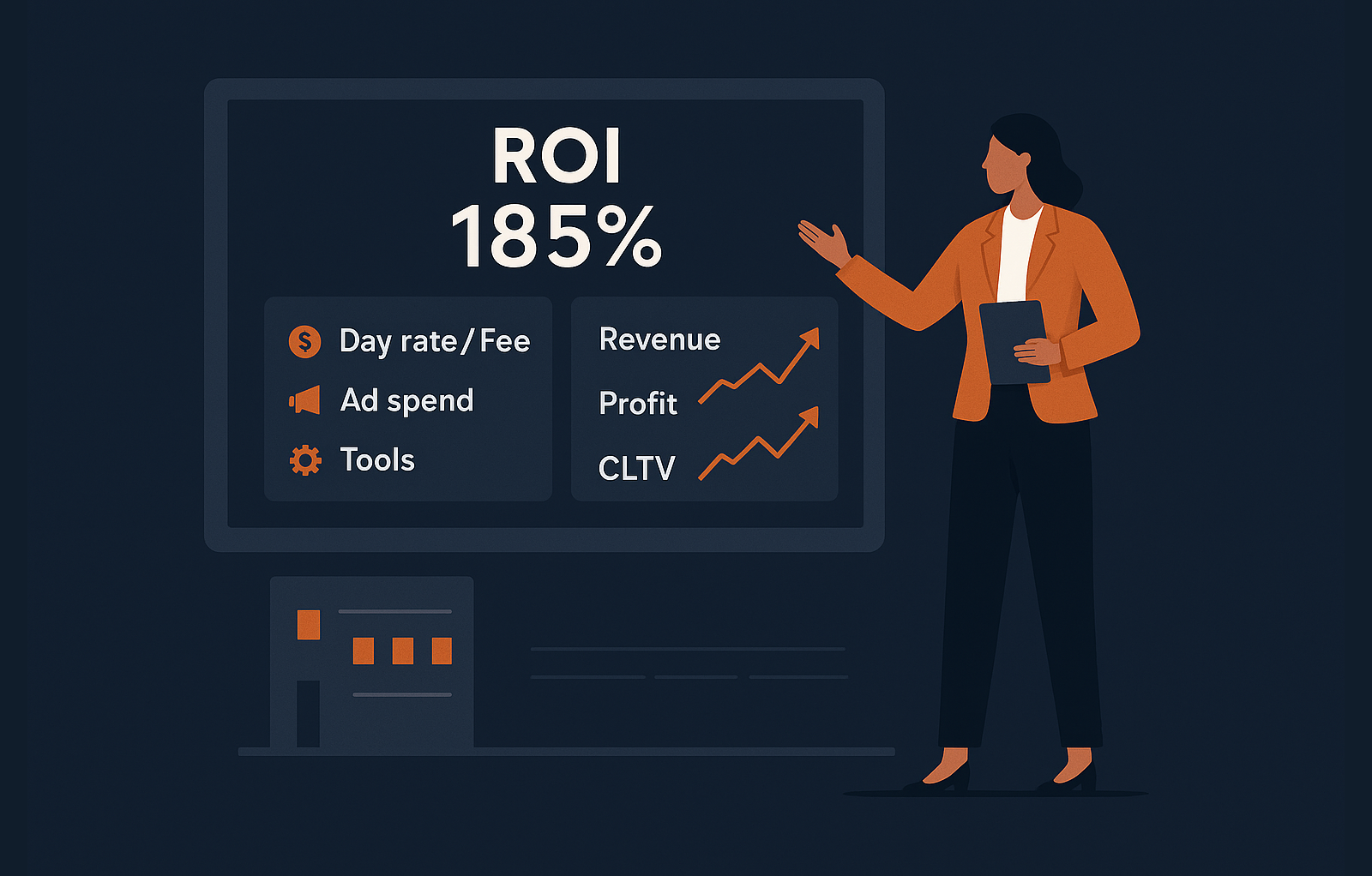
Bringing in a fractional marketing leader can feel like the right move – senior expertise, strategic clarity, better use of budget. But sooner or later, someone (often your FD or an investor) will ask:
“What exactly are we getting for this fee?”
If you can’t answer that clearly, the engagement will always feel fragile, no matter how good the work is.
The good news: you can measure the ROI of a fractional marketing leader – you just need to be deliberate about it from day one.
Here’s how to do it.
1. Get clear on the cost (properly)
Before you can measure return, you need to know what you’re actually investing.
That’s not just their day rate. Think of:
- Fractional leader fees – retainer, day rate, or project fee
- Knock-on investments they recommend – e.g. ad budget increase, new tools, extra resource
- But also savings they create – e.g. cutting wasted spend, consolidating tools, reducing agency costs
For the purpose of their ROI, start with:
Total cost of fractional leader over X months
(e.g. £4,000/month × 6 months = £24,000)
We’ll come back to this when we talk about uplift.
2. Establish a baseline before they start
This is the step most businesses skip – and then wonder why ROI feels fuzzy later.
Before your fractional leader gets going, snapshot where you are today. For example:
Top-line numbers:
- Monthly revenue (by channel, if possible)
- Gross margin %
- Marketing spend (total and by channel)
- Contribution margin (revenue – direct costs – marketing spend)
Key marketing performance metrics:
- Website conversion rate
- Average order value (AOV) or average deal size
- Cost per lead / cost per acquisition
- ROAS / MER (marketing efficiency ratio)
- Repeat purchase rate or lead-to-opportunity / opportunity-to-sale rates
Operational / qualitative reality:
- How decisions are made (“gut feel”, “agency tells us”, “no idea”)
- How the team feel (overwhelmed, unclear, underused)
- How confident you are in your numbers (1–10)
It doesn’t need to be perfect – but capture enough that you can say, six months later: “Here’s where we started.”
3. Agree what success looks like (and over what time frame)
ROI is impossible to measure if you never agreed on what “good” looks like.
With your fractional leader, define:
- Primary goal(s) – no more than three
- e.g. “Increase online revenue by 25% while maintaining margin”
- e.g. “Reduce blended CPA by 20%”
- e.g. “Double the volume of sales-qualified leads at the same spend”
- Time frame
- 90 days for foundations and quick wins
- 6–12 months for fuller ROI
- Constraints
- “We can’t increase paid media budget for 3 months”
- “We have limited dev resource”
- “We must protect distributor relationships”
Write this down. This is the lens you’ll use to judge ROI later.
4. Measure financial ROI in a simple way
Now to the bit everyone cares about: money.
Step 1: Look at incremental profit, not just revenue
Revenue is nice. Profit is better.
You want to know:
“By how much did profit improve relative to their cost?”
Rough-and-ready way to think about it over the period:
- Calculate contribution before they started
- Contribution = Revenue – Cost of Goods – Marketing Spend
- Calculate contribution after they’ve had time to make an impact
- Same formula, but now with new revenue and spend levels
- Work out the uplift
- Contribution uplift = Contribution (after) – Contribution (before)
- Compare that uplift to their cost
For example, over 6 months:
- Before: average monthly contribution = £80,000
- After: average monthly contribution = £95,000
- Uplift = £15,000/month → £90,000 over 6 months
Fractional leader cost over 6 months = £24,000
Very simple ROI:
ROI = (Uplift – Cost) ÷ Cost
= (£90,000 – £24,000) ÷ £24,000
= 2.75 → 275% ROI
Is it perfect? No. Is it good enough for board-level conversations? Yes.
Step 2: Include cost savings as part of ROI
A good fractional leader doesn’t just drive more revenue – they often stop you wasting money:
- Killing unprofitable campaigns
- Consolidating tools and subscriptions
- Negotiating smarter with agencies
- Stopping “pet projects” that never deliver
If they’ve saved, say, £2,000/month in wasted spend without harming performance, that’s £12,000 over 6 months – add that to the “uplift” side of the equation.
Suddenly, they’re not just a cost – they’re actively paying for themselves.
5. Track leading indicators (the early wins)
Financial ROI often lags. You may not see the full impact on revenue and profit for several months, especially in longer sales cycles.
That’s where leading indicators come in. These are earlier signals that things are moving in the right direction.
Examples:
- Website conversion rate up from 1.2% → 1.8%
- AOV up from £95 → £110
- Email now contributing 15% of revenue, up from 6%
- Blended CPA down from £50 → £38
- ROAS improved on key campaigns
- Lead-to-opportunity conversion rising
- Sales cycles shortening
These are all things a fractional leader should be influencing before the full revenue impact lands.
Agree which leading indicators you’ll track together, and review them monthly.
6. Don’t ignore non-financial ROI (but make it visible)
Some of the biggest benefits are harder to quantify but still very real:
- Founder time freed up from trying to “do marketing” themselves
- Better decisions – fewer knee-jerk changes to strategy
- Calmer team – less chaos, clearer priorities
- Stronger marketers – team members levelling up under proper leadership
- Cleaner data – you can actually trust your numbers now
- Better agency relationships – clearer briefs, more accountability
You can still measure some of this:
- Ask your team and key stakeholders to rate, monthly or quarterly (1–10):
- Clarity of marketing priorities
- Confidence in the plan
- Quality of cross-team communication
- Stress levels around marketing and launches
- Log founder time – roughly how many hours per week you spent on marketing decisions before vs after
These won’t go into a strict ROI formula, but they absolutely matter when deciding whether to continue the engagement.
7. Use a simple monthly scorecard
To keep it practical, you can roll all of this into a one-page scorecard reviewed every month.
For example, rate each area 1–5:
- Growth & revenue impact
- Are key financial metrics moving in the right direction?
- Efficiency & spend quality
- Are we getting more from the same budget, or the same from less?
- Clarity & decision-making
- Do we know our priorities? Are decisions faster and better?
- Team capability & confidence
- Are our marketers and sales team more capable and aligned?
- Founders’ peace of mind
- Do we feel in control of marketing, or still in the dark?
Over 3–6 months, you should see those scores trend upwards alongside your financial metrics. If not, that’s a red flag.
8. Be realistic about attribution
One important nuance: a fractional marketing leader doesn’t work in a vacuum.
Sales, product, operations, the economy – all of these affect performance.
You’re not trying to prove that “every extra pound came solely from them”. Instead, ask:
- Are we performing meaningfully better than our baseline in the areas they influence?
- Would we realistically have made the same progress without their involvement?
If:
- Revenue and contribution are up
- CPAs are down or stable
- Marketing feels more controlled and less chaotic
- The team is clearly stronger
- And this all happened after bringing them in
…you can be confident you’re getting positive ROI, even if you can’t attribute every penny perfectly.
9. When to question the ROI
It’s equally important to know when things aren’t working.
Start asking hard questions if:
- There was no clear baseline and still no clear metrics
- You’re getting a lot of activity but no noticeable shift in outcomes
- Reporting is full of vanity metrics (impressions, likes) but light on revenue, margin and CPA
- The team still seem as lost or overwhelmed as before
- You’ve been working together for 6+ months and:
- Revenue is flat or down with no clear explanation
- Efficiency hasn’t improved
- There’s no strong case for “we’d be worse off without this”
At that point, either the scope is wrong, or the relationship is.
Bringing it all together
Measuring the ROI of a fractional marketing leader isn’t about building a perfect financial model. It’s about answering, with a straight face:
- Are we making more money, more efficiently, than before?
- Is our marketing function stronger and more controlled?
- Has this person’s involvement clearly moved us forward?
If you establish a baseline, agree clear goals, track both financial and non-financial impact, and review everything with a simple scorecard, you’ll know the answer.
And if the answer is “yes”, their fee stops feeling like a cost – and starts looking like one of the smartest investments you’ve made.
Leave a Reply