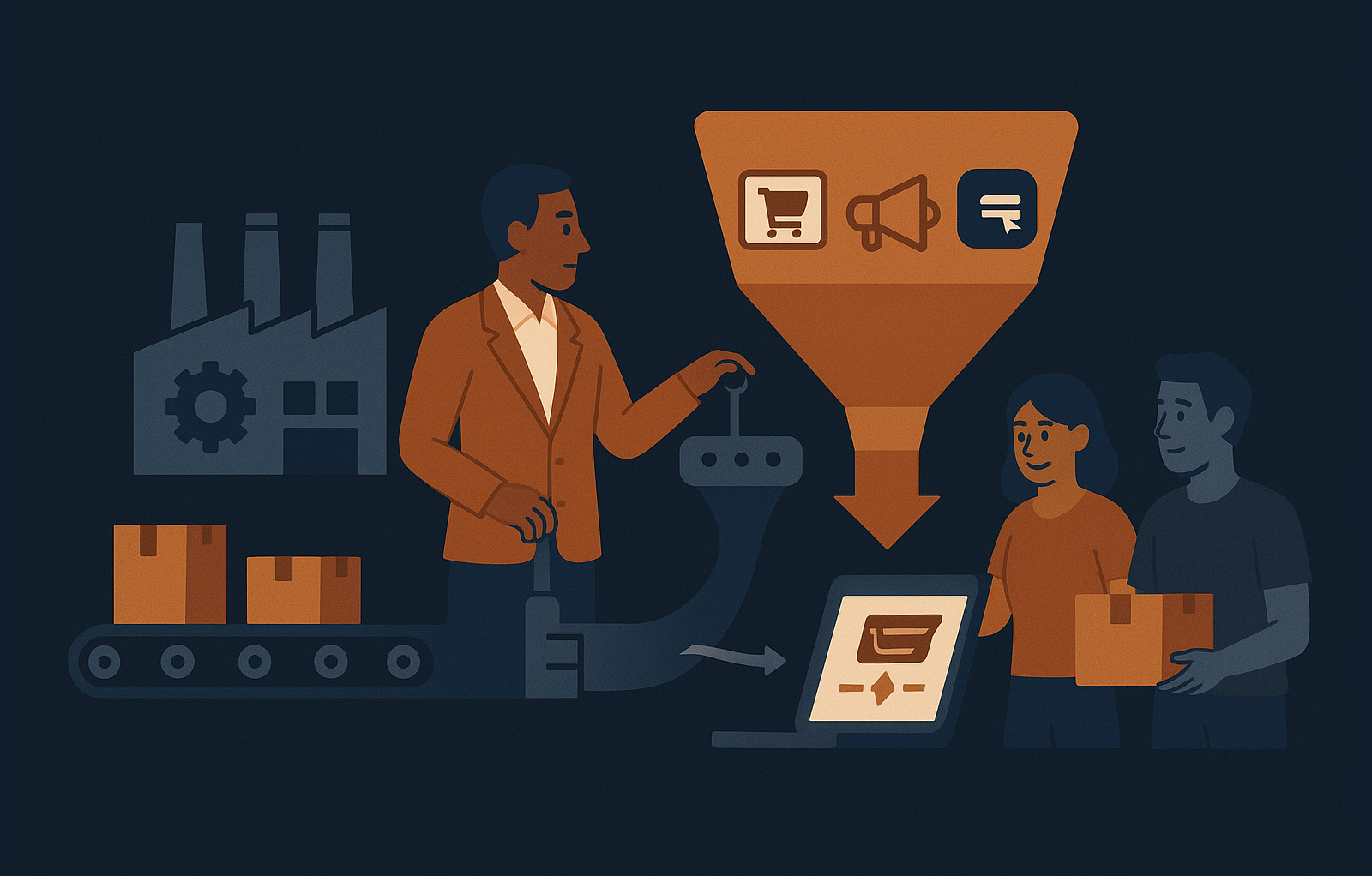
Here’s how they actually help manufacturers go direct to consumer, step by step.
1. Start with “why D2C?” – and give it a clear job
The biggest mistake manufacturers make is treating D2C as a shiny bolt-on:
“We’ll stick a web shop on the site and see what happens.”
A good fractional marketing leader starts with a different question:
- What job is D2C going to do for this business?
For example, D2C might be there to:
- Improve margins on selected products
- Test new products, bundles or pricing before pushing them to retail
- Build a direct relationship with end users (data, feedback, reviews)
- Serve niches your distributors ignore because they’re “too small”
- Support your brand story with educational content and support
They’ll help you define a tight, realistic role for D2C so it supports your existing channels rather than randomly competing with them.
2. Design D2C so it doesn’t blow up your trade relationships
Channel conflict is the thing that keeps most manufacturers from moving.
A fractional marketing leader will work through questions like:
- Which products should be sold D2C, and which should stay trade-only?
- How do we structure pricing so we’re not publicly undercutting distributors?
- Can we differentiate by range, service or experience rather than price?
- How do we communicate this clearly to our partners?
That often leads to decisions such as:
- Limiting D2C to certain SKUs, bundles or spare parts
- Keeping some “trade only” lines or pack sizes
- Adding value D2C (content, support, customisation) rather than simply discounting
- Agreeing simple channel rules internally so sales don’t panic every time a D2C order arrives
The aim isn’t to “sneak D2C in”. It’s to create a channel strategy where your distributors still have a clear role, and D2C fills the gaps they were never going to fill well anyway.
3. Translate product thinking into consumer language
Most manufacturers talk in specs, part numbers and tolerances.
End consumers do not.
A fractional marketing leader helps you:
- Define who you’re selling to directly (DIYers? hobbyists? small workshops? pros buying for themselves?)
- Translate your technical strengths into benefits people actually care about
- Position your brand as something more than “another supplier of X”
That might involve:
- Rewriting product descriptions so they’re understandable and persuasive
- Creating comparison pages that help people choose the right product
- Building guides, how-tos and usage content that reduce returns and increase confidence
- Using your heritage, quality and technical expertise as part of the brand story
They bridge the gap between engineering reality and consumer decision-making.
4. Choose the right D2C tech stack (without overcomplicating it)
You don’t need a monster ecommerce build to test D2C.
A fractional marketing leader will usually:
- Recommend a sensible platform (often Shopify for most manufacturers starting out)
- Keep the stack lean: ecommerce, email, reviews, analytics, maybe a basic CRM
- Avoid over-engineering “because one day we might need…”
They’ll focus on:
- Making it easy for customers to buy the handful of products that matter most
- Ensuring tracking is set up properly from day one
- Integrating with your existing systems just enough to avoid operational chaos, without trying to rebuild your whole ERP around D2C in phase one
The goal is a simple, robust D2C engine – not a two-year IT project.
5. Decide what to sell first (and what to leave alone)
Not every product belongs in a D2C catalogue.
A fractional marketing leader will help you:
- Identify hero products suitable for D2C – high demand, good margin, easy to ship
- Create bundles and kits that solve real problems (and differentiate from your trade offer)
- Decide which lines are a terrible idea to send through courier networks (oversized, fragile, low-margin bulk, etc.)
They’ll push you to launch with a focused range instead of dumping your entire catalogue online.
This concentration makes marketing easier, conversion higher, and operational headaches smaller.
6. Build a realistic go-to-market plan (not just “run some ads”)
Going D2C is not just “turn on Google Ads”.
Your fractional marketing leader will:
- Choose 1–2 primary channels to start with (e.g. Google Shopping + Meta ads, or search + email)
- Define a test budget and a clear way of measuring success
- Create a simple launch plan: pre-launch interest, launch offer, follow-up
- Design an initial retention journey – email flows for new customers, cross-sell, and repeat purchase
Crucially, they’ll link every activity to:
- A target CPA / ROAS
- A target contribution margin
- A feedback loop into product and ops (e.g. which SKUs are flying, which are causing support issues)
They’re not there to fiddle with ad buttons all day – they’re there to own the commercial logic behind your marketing.
7. Protect operations and customer experience
D2C exposes you to things your distributors used to absorb:
- Last-mile delivery issues
- Fussy customers
- Returns and refunds
- Packaging complaints
- “Where’s my order?” emails
A fractional marketing leader will:
- Work with ops and customer service to set realistic promises on delivery and returns
- Help define packaging and unboxing standards that protect the product and the brand
- Build clear FAQs, help content and post-purchase comms to reduce pressure on the phone lines
- Use customer feedback and reviews to improve products and processes
They’ll make sure your first impression in the consumer world is positive and sustainable, not a flood of one-star reviews because you copied your wholesale processes directly over to B2C.
8. Align sales, finance and the board
D2C fails inside manufacturers more often because of internal politics than external performance.
A fractional marketing leader helps:
- Sales understand that D2C is not there to “steal their orders”
- Finance see a clear plan for payback, not an open-ended cost centre
- The board see how D2C supports valuation, resilience and brand strength
They’ll put in place:
- Simple, agreed reporting on D2C performance
- Guardrails on pricing and discounting
- Clear agreements on how to handle overlaps with key accounts
In other words, they make D2C feel like a planned part of the commercial strategy, not a rogue side project.
9. Build capability, not dependency
Finally, a strong fractional marketing leader isn’t trying to become permanent.
While they’re with you, they will:
- Put structure and rhythm around D2C marketing (plans, reviews, reporting)
- Up-skill your internal team or help you hire your first ecommerce/marketing roles
- Create playbooks and processes (campaign templates, email flows, launch checklists)
The idea is that, over time:
- Your team can run the D2C channel confidently
- You know which levers to pull to grow it further
- You can choose whether to keep them on in a lighter-touch role or bring more in-house
You’re not just buying “some help with ads”. You’re building a new muscle in the business.
In summary
Manufacturers don’t go D2C just by putting a “Buy Now” button on the website.
They succeed when someone:
- Defines a clear role for D2C in the overall channel mix
- Protects trade relationships while opening up new opportunities
- Translates technical products into consumer-friendly offers
- Chooses a sensible tech stack and a focused product range
- Builds a testable, numbers-driven go-to-market plan
- Keeps operations, sales, finance and the board aligned
- Leaves behind a stronger team and function than they found
That’s what a good fractional marketing leader does for manufacturers going direct to consumer: they turn D2C from a risk and a rumour into a controlled, profitable, strategically useful channel.
Leave a Reply