A lot of B2B brands look at D2C and see “more margin”.
“If we sell direct, we don’t have to give away 40–60% to distributors and retailers. We’ll make a fortune.”
On paper, it sounds brilliant. In reality, if you don’t understand the unit economics, D2C can quite easily become:
- A distraction for your team
- A drain on cash
- A source of awkward questions from your board
Before you brief agencies, choose platforms or build a fulfilment operation, you need to answer a simple question:
“Can we acquire, serve and retain a D2C customer profitably?”
That means understanding the true cost of D2C – not just the extra margin you think you’ll gain.
Let’s break it down.
1. The “D2C profit illusion”
When you move from wholesale to D2C, the shape of your P&L changes.
Wholesale model (simplified)
- Sell to distributor for £40
- They sell to end customer for £80
- Your gross margin might be, say, £20 after cost of goods (COGS)
D2C fantasy version
- Sell to end customer for £80
- COGS still £20
- “We’ve just added £40 to our margin!”
Except you haven’t. You’ve simply swapped the distributor’s margin for your own set of costs:
- Customer acquisition (ads, social, affiliates)
- Pick, pack and delivery
- Returns and refunds
- Payment fees
- Customer service
- Platform, apps and tech overheads
If you don’t quantify these properly, you’ll be flying blind.
2. The core variables you must know
To understand D2C unit economics, you need a view on a handful of key metrics. You don’t need perfection, but you do need a sensible starting point:
- Average Order Value (AOV)
The average amount a customer spends per order. Higher AOV gives you more room to cover costs. - Gross margin per order
Selling price minus COGS (product cost, inbound freight, duties). This is your raw fuel. - Customer Acquisition Cost (CAC)
How much you spend on marketing to acquire one new customer.
Example: if you spend £5,000 on paid media and get 200 new customers, your CAC is £25. - Fulfilment cost
Pick, pack, packaging, and delivery. Don’t forget surcharges and rural/remote realities. - Return rate and refund cost
Particularly critical for apparel, footwear and high-touch products. - Payment fees
Card and payment processor fees (often 1–3% of order value, plus flat charges). - Customer Lifetime Value (LTV)
Revenue (or margin) that an average customer generates over a defined period (e.g. 12 or 24 months), minus the associated costs.
Once you’ve estimated these, you can sketch out whether a typical D2C customer is likely to be profitable – or not.
3. A simple worked example
Let’s say you’re a B2B brand considering selling a £80 product D2C.
Per order
- Selling price (inc. VAT): £80
- COGS (product, inbound freight, duties): £30
- Gross margin: £50
Costs per order:
- Customer acquisition cost (first order): £25
- Fulfilment (pick, pack, packaging, delivery): £7
- Returns allowance (10% of orders, with partial resale): £3
- Payment fees (say 2%): £1.60
- Customer service allowance: £1.50
Total variable costs (excluding COGS): £38.10
Contribution after marketing and fulfilment:
- Gross margin: £50
- Minus variable costs: £38.10
- Profit contribution per first order: £11.90
On the surface, that’s not too bad – but remember, you still have:
- Platform fees and apps
- Salaries for ecommerce, trading and marketing
- Warehouse overheads (if in-house)
- General overhead allocation
You might decide:
- “We’re comfortable making ~£10 on the first purchase, because we expect people to come back.”
- Or, “We need at least £15–£20 per order to cover overhead and still have room to invest.”
Either way, you’ve at least made the economics visible.
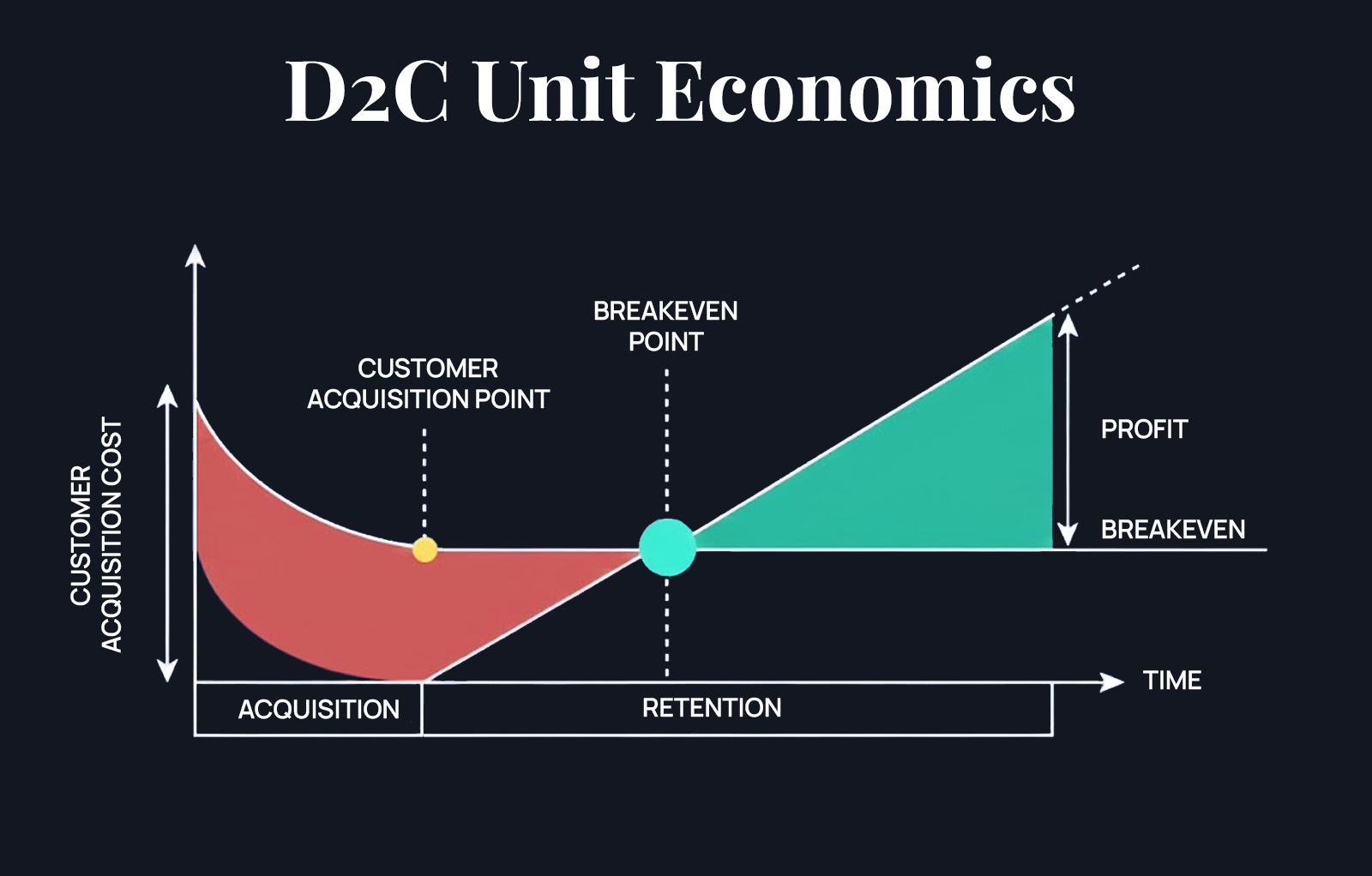
4. The role of repeat purchase and LTV
The first order is rarely where the real profit lies.
D2C becomes powerful when you can acquire a customer once and sell to them multiple times, with lower or zero acquisition cost on subsequent orders.
Continuing the example:
- First order:
- CAC: £25
- Contribution: £11.90
- Second order (from email/CRM, no paid CAC):
- Same product and costs, but CAC now effectively £0
- Contribution per order becomes: £36.90 (because you’ve removed £25 of paid media cost)
Now imagine:
- The average customer buys 1.7 times in the first year.
- You’re breakeven or modestly profitable on order one, then significantly profitable from order two onwards.
That’s why understanding LTV is so important:
If your average LTV is high and your repeat purchase rate is strong, you can afford a higher CAC up front.
If your product is rarely repurchased (large one-off capital items, for example), you cannot justify the same acquisition cost as a consumable or subscription product.
5. Fixed vs variable costs: don’t forget the boring bits
A common mistake is to focus only on variable costs per order, and ignore the fixed costs that come with a D2C channel.
For example:
- Ecommerce platform / licence
- Apps, plugins and integrations
- Agency retainers or external specialists
- Partial salary costs for people who will spend time on D2C
- Photography, creative and content production
- Warehouse rent, equipment and systems
These don’t change with each order, but they must be covered by the contribution you make across all orders.
A simple way to sanity-check this is:
- Estimate your monthly fixed costs for D2C (platform, people, agency, overhead contribution).
- Divide that by your expected monthly contribution per order.
- That tells you how many orders you need per month just to break even on the overhead.
If that required order volume looks wildly optimistic based on your realistic traffic and conversion assumptions, you have a problem.
6. Red flags in D2C economics
As you model the numbers, a few patterns should make you pause:
- AOV too low, shipping costs too high
If you’re selling low-ticket items with heavy or awkward shipping, fulfilment can eat your margin. - High returns with low resale value
Fashion brands know this pain. If 30–40% of your orders are coming back, your economics change dramatically. - CAC rising faster than AOV or LTV
Paid media costs tend to creep up. If you don’t improve conversion, AOV or repeat purchase, you quickly get squeezed. - Dependence on discounting to convert
If you can only hit your conversion targets at 20–30% off, you’re training customers to wait for sales and compressing your margin. - Overly optimistic repeat purchase assumptions
“They’ll buy every month” is a nice thought. The data often says otherwise. Assume less and be pleasantly surprised, not the other way round.
If you spot these early – on a spreadsheet rather than in your P&L – you can adjust your strategy before committing significant budget.
7. A quick D2C economics checklist
Before you sign off on a D2C launch, you should be able to answer “yes” to most of the following:
- We’ve estimated our AOV, gross margin and key cost components per order.
- We understand our likely CAC, based on realistic benchmarks or tests, not guesswork.
- We’ve modelled at least three scenarios (conservative, expected, optimistic) for CAC, AOV and repeat purchase.
- We know what contribution we need on the first order to make D2C sustainable.
- We’ve factored in platform, people, agency and other fixed costs into our breakeven calculation.
- We have a clear plan to drive repeat purchase (email, content, subscriptions, loyalty), not just one-off sales.
- We know the circumstances under which we’d stop or rework the channel (e.g. CAC above £X for Y months).
If you can’t yet tick these off, your first job isn’t “launching D2C”. It’s getting the numbers straight.
8. The upside of doing the maths
This might all sound a bit sobering. But actually, this kind of clarity is liberating.
- You’ll launch with realistic expectations rather than hopeful targets.
- You’ll know what levers to pull when performance is off (AOV, CAC, conversion, repeat).
- You’ll be able to explain to your board and your team what “good” looks like – and why you’re investing.
Most importantly, you’ll avoid the trap of thinking:
“D2C isn’t working”
when the truth is:
“We never actually defined what ‘working’ meant in numbers.”
Understanding the true cost of D2C doesn’t kill the opportunity. It makes it real.
And once it’s real, you can decide whether D2C is an experiment, a meaningful growth channel, or something you should park for now and revisit later with better economics on your side.
Leave a Reply