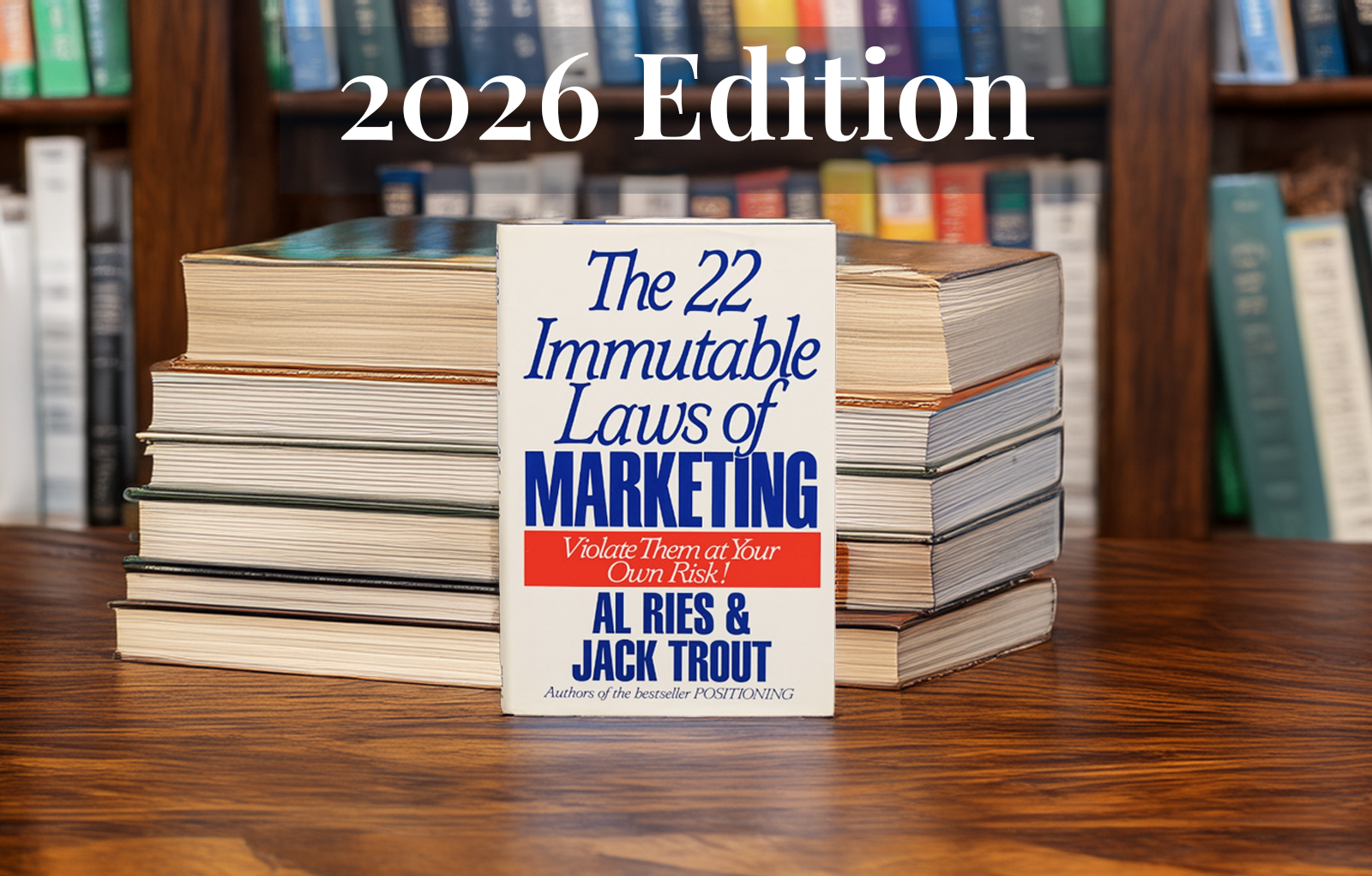
I first read The 22 Immutable Laws of Marketing long after it was published, but it stayed with me in a way most marketing books don’t. Not because every example still fits, and not because the world hasn’t changed, but because it tries to describe how marketing behaves when real money is on the line.
Al Ries and Jack Trout published the book in 1994. Calling the laws “immutable” was a bold move even then, and it can sound almost ridiculous now. But if you read it with the right lens, “immutable” doesn’t mean “nothing ever changes”. It means the underlying forces don’t shift much: attention is limited, people simplify, categories form, leaders tend to win, and confusion kills momentum.
Since 1994, almost everything about execution has changed. We’ve had search, social, smartphones, marketplaces, subscription business models, privacy regulation, creator-led distribution, and a world where customer experience is public. That doesn’t make the original laws obsolete. It just means some of them need translating.
Why the book still matters
Most growth problems I get pulled into aren’t “we need a new channel”. They’re usually one of these:
- We’re spending more, but it isn’t turning into momentum.
- We’ve got lots of activity, but nothing is compounding.
- The product is strong, yet the market doesn’t seem to “get it”.
- Our messaging is clever, but sales are flat.
- We’ve extended the range and now nobody knows what we stand for.
Those are not tactical problems. They’re strategy problems. That’s why this book has lasted. Underneath the snappy laws, it’s really about two things: owning a space in the customer’s mind, and making it easier for the market to choose you.
The laws that still hold up (almost unchanged)
If you forced me to keep only a handful of the original laws, I’d keep these.
Perception and Mind.
Marketing isn’t a battle of products; it’s a battle of perceptions. This is even more true now because people have more choice, less patience, and a constant stream of competing messages. You don’t win by being “better”. You win by being clearer.
Focus and Sacrifice.
Trying to appeal to everyone is the easiest way to become forgettable. I see this constantly as businesses grow: more products, more audiences, more messages, and suddenly growth slows down. Not because the company got worse, but because the brand got fuzzier. Focus isn’t a limitation. It’s a lever.
Category and Leadership.
Most markets still reward leaders. Digital often amplifies that effect. Reviews, rankings, and algorithms nudge people towards what’s already winning. You can absolutely grow without being number one, but you need a deliberate strategy for how you win if you aren’t the leader.
Candour and Hype.
The book’s point about hype is simple: the market eventually finds out. In 2025 it finds out faster, and it shares what it finds out. Honest framing, clear expectations, and evidence-based claims are not just “brand values”. They are commercial advantages.
The laws that need adapting for 2025
Some of the originals are directionally right, but the mechanics have changed.
The Law of the Ladder (updated: ladders are now platforms).
In 1994, the “ladder” was reinforced by what people saw on shelves and in mass media. In 2025, there are multiple ladders: Google results, Amazon category pages, TikTok feeds, Trustpilot ratings, app store rankings, industry comparison lists. You’re not only competing in the customer’s mind; you’re competing inside discovery systems.
This shifts strategy back to fundamentals. Platforms reward relevance, and relevance comes from clarity. If you can’t explain who you’re for and why you’re different in a sentence, the algorithm struggles too.
The Law of Line Extension (updated: extensions can work, but only with a spine).
The book is famously anti line-extension. The warning is still valid: range expansion is one of the quickest routes to diluted positioning.
But modern brands can extend successfully when there is a strong organising idea, such as a mission, an audience, or a problem-space. If you extend because you want more revenue, you usually create confusion. If you extend because it strengthens the brand’s identity and usefulness, you can build an ecosystem.
A simple test: if a customer can’t instantly answer “why is this product from you?”, you’re extending for internal reasons, not market reasons.
The Law of Resources (updated: distribution is the real resource).
Money still helps, but the bigger differentiator now is whether you own a compounding distribution engine. Paid media can get you started, but it doesn’t protect you. A business becomes resilient when it has at least one channel that gets stronger over time: SEO, email, partnerships, community, product-led referrals, repeat purchase behaviour, or a creator network.
When I’m assessing growth potential, I’m less interested in “which channels are you running?” and more interested in “what’s going to get cheaper for you as you scale?”
The Law of Perspective (updated: the feedback loop is shorter).
Marketing still rewards patience, but the signals arrive faster now. You can learn in days what used to take months. That’s an opportunity, but it’s also a trap. Many teams overreact to weekly noise and slowly lose the strategic thread.
The modern version of “perspective” is this: play long-term games, but instrument them so you can learn weekly without changing direction weekly.
What a 2025 edition would add
If the book were written today, I’d keep the spirit, short laws that force clear thinking, but I’d add a few that reflect how brands actually grow now.
1) The Law of Proof
Claims are cheap. Proof is persuasive. Reviews, case studies, comparisons, user-generated content, demos, performance data, and “show your work” content are not nice-to-haves. In many categories, they are the product’s marketing layer.
2) The Law of Trust
Trust has become the main growth constraint. People are more sceptical, more informed, and quicker to share bad experiences. You can still buy attention, but you can’t buy belief for long. The brands that win are the ones whose experience matches their promise consistently.
3) The Law of Experience
In 1994, you could get away with a gap between marketing and reality for longer. In 2025, the gap gets exposed quickly and publicly. Pricing, delivery, returns, customer support, onboarding, the tone of your emails, how you handle complaints, it all either reinforces your positioning or undermines it.
4) The Law of Retention
Retention isn’t just a metric; it’s a strategy. Improve repeat purchase rate, onboarding, product usage, customer service, and post-purchase communication, and you often reduce acquisition costs because the business stops leaking value. Retention turns marketing from a treadmill into a flywheel.
5) The Law of Compounding Distribution
Campaigns spike. Systems build. The healthiest businesses I see have at least one engine that compounds: content that ranks, email that nurtures, partnerships that repeat, community that advocates, product that gets shared, or a reputation that attracts demand before a click is even bought.
So, are the laws still “immutable”?
The labels aren’t immutable. Some of the original examples feel like artefacts of another era. But the deeper message is close to timeless:
- The market rewards clarity.
- Customers choose based on simplified perceptions, not full information.
- Strong brands are built through focus and consistency, not endless reinvention.
- Growth gets easier when you create compounding advantages, not isolated tactics.
That’s why the book still earns its place on the shelf. Not as scripture, but as a reminder that marketing is not a bag of tricks. It’s the discipline of deciding what you will be known for, then building the proof and the distribution to make that true.
In 2025, the “laws” of marketing haven’t broken. They’ve just moved house. The shelf is now a search page. Word-of-mouth is now a review feed. The broadcast is now an algorithm. The same forces are at play, just faster, louder, and less forgiving.
And in a strange way, that makes the original book more relevant, not less. Because when the world speeds up, the businesses that win are usually the ones with the clearest strategy.
Leave a Reply